
In 1925, Huntsville’s resident elites – the people who for all intents and purposes controlled the political and economic lifeblood of the city – seized upon an idea. They would organize an event that simultaneously highlighted local businesses and cajoled people into patronizing them. From May 3-9, 1925, they hoped to inspire residents to “Be Loyal to Huntsville.”
The early 20th century saw a slew of changes in how people purchased and consumed products. For decades, clerks weighed out grocery orders, porters delivered them to individual homes, and hometown merchants traveled to regional bazaars to procure more exotic goods for local resale. People lived and died within a complex web of creditors and debtors. Each market was little less than its own ecosystem.
Companies like Sears and Piggly Wiggly changed that math. Sears’ Catalog brought the world (and many of its regional bazaars) to your doorstep, people could literally get their next house delivered in the mail. This meant that merchants who previously made their living as professional middle men were suddenly threatened. Although the local and regional retailer hung on for decades yet, they sensed early that competition was to become more fierce.
Piggly Wiggly eschewed traditional labor standards by forcing customers to pick out their own prepackaged goods. Clerks now simply collected cash and assisted people in findings things, they no longer took orders or collected grocery bills. Clarence Saunders, Piggly Wiggly’s founder, focused on franchising and the self-service grocery method soon spread throughout the southeast. Without the need for a small army of clerks stores could offer lower prices and often put local retailers out of business.
It is this national climate, where faraway markets now dominated local commerce, that prompted Huntsville’s business community and resident elites to begin organizing around the concept of regional and city loyalty. Throughout the early 1920s a focus on the needs of “home merchants” became more prominent and newspapers bragged about turning down advertising orders from rival communities in Chattanooga, Birmingham, and Atlanta.1
To be certain there were previous exhortations to the “loyal citizens of Huntsville” throughout the years. Whenever the city hosted a large conference or had visiting dignitaries, local newspapers called for the city to present itself well. Yet these previous instances were about putting forward the best possible face to visitors and outsiders. It was only after the commercial pressures presented by competing firms in nearby cities, retail franchising, and the ever-present threat of the Sears catalog that resident elites began pressuring the people of Huntsville to show their hometown pride by meeting their consumption needs from local merchants first.2
Precursors to the “Be Loyal to Huntsville” week appeared at least a year earlier with an advertisement titled “All Aboard For Prosperity via Greater Huntsville.”3 The train to prosperity passing through the city was an iconic image, one that its creators used often in their advertisement campaigns. The national market forced cities to not only compete with one another for business, but to try and differentiate themselves as places of commerce and opportunity. It is ironic that so many towns turned to the same advertising firm to highlight their unique characteristics. The F.G. Hogan Syndicate operated out of Kane, Pennsylvania and literally drew up the template that towns nationwide used to try to sell themselves to locals and outside businessmen.

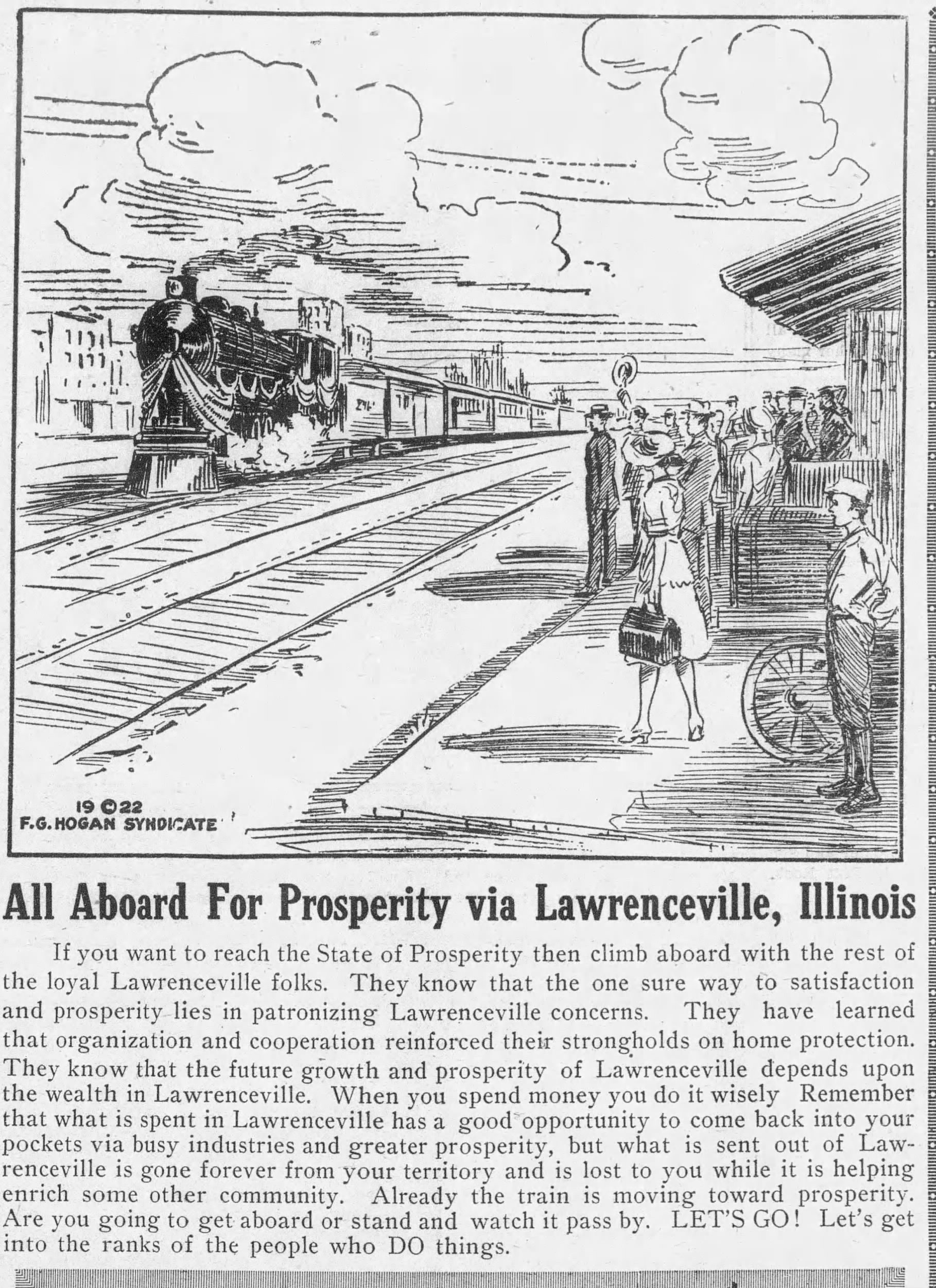

However, Huntsville’s resident elites often managed to set the city apart. Rather than simply copy what worked elsewhere they focused on both loyalty and the concept of Greater Huntsville – the long-promised annexation of surrounding communities into the city itself. Huntsville planned to expand outwards, to continue on the seemingly natural path of progress that transformed Madison county from a cotton producing monolith to a diversified economy with suburbs, factories, and slums. To that end resident elites demanded the loyalty of not just the city dwellers but of the entire region’s population.
Huntsville’s parochialism proved intense even in an era of fierce competition and a focus on hometown loyalty. Thus the “Be Loyal to Huntsville” campaign launched in Spring 1925 is an historically significant event that highlighted not only the depths of inter-city rivalries but how completely the rhetoric and realities of the New South era transformed Huntsville’s self-perception.
The phrase emerged in March 1925. The first instance of “Be Loyal to Huntsville” was not directly associated with the upcoming loyalty week but instead emerged from a dramatic advice column-cum-advertisement for the Chamber of Commerce. Huntsville Times editor J.E. Pierce attempted to anthropomorphize not only the concept of loyalty, but his readers monetary interests. “I am your payroll,” his column proclaimed, and only by cooperating with other local businessmen could one hope to prosper in this new world where regional markets were wracked by increasingly intense external forces.4
Pierce’s column continued its dramatic flairs. By late March his campaign to demand loyalty to local businesses took on a Biblical tone when he consciously aped the Ten Commandments. “Thou shalts,” littered the column and it touched on all the concerns and contrasts of the Progressive movement. Pierce’s pronouncements were the KJV, City Beautiful, and Good Roads movement in one fell swoop. There were calls to combat the “death that lurks in the marshes,” to increase access to sunlight to drive out tuberculosis, to “build good roads and keep them good.” The zeal and willingness to mix religion and middle class interests typified not just the Progressive era but Huntsville itself. No wonder that Pierce’s final sentence returned to the authority of the commandments: “Thou shalt be loyal to Huntsville.”5

By late March other resident elites heard the beat of Pierce’s drum. The Chamber of Commerce, downtown churches, and major fraternal and civic organizations like the Kiwanis and Acme Clubs all announced their support for a week dedicated to Huntsville, its people, and businesses. The planning committee consisted of the most prominent men in the city. Former mayors, prosperous grocers, bankers, attorneys, and the county health officer not only endorsed the plan but volunteered their time and talents to the enterprise. Their participation proved less than philanthropic. These men stood to benefit the most because they owned the businesses and led the social institutions that demanded the loyalty of thousands of residents of Greater Huntsville.6
Loyalty took on many forms in 1925. Promoting Huntsville’s nascent baseball league established one as a loyal citizen. As did stumping for annexation of more nearby territories. Attending church was sure to prove one’s loyalty. In response, area churches coordinated on special services that stressed commitment to community. Although the ‘loyalty week’ proved an overwhelmingly white endeavor, there are glimpses of the Black community’s participation. For instance a choir from Alabama A&M performed “negro spirituals” at the city high school to celebrate both Music Week and the loyalty week. Unlike many things in the early 20th century south, loyalty apparently crossed the color line. 7
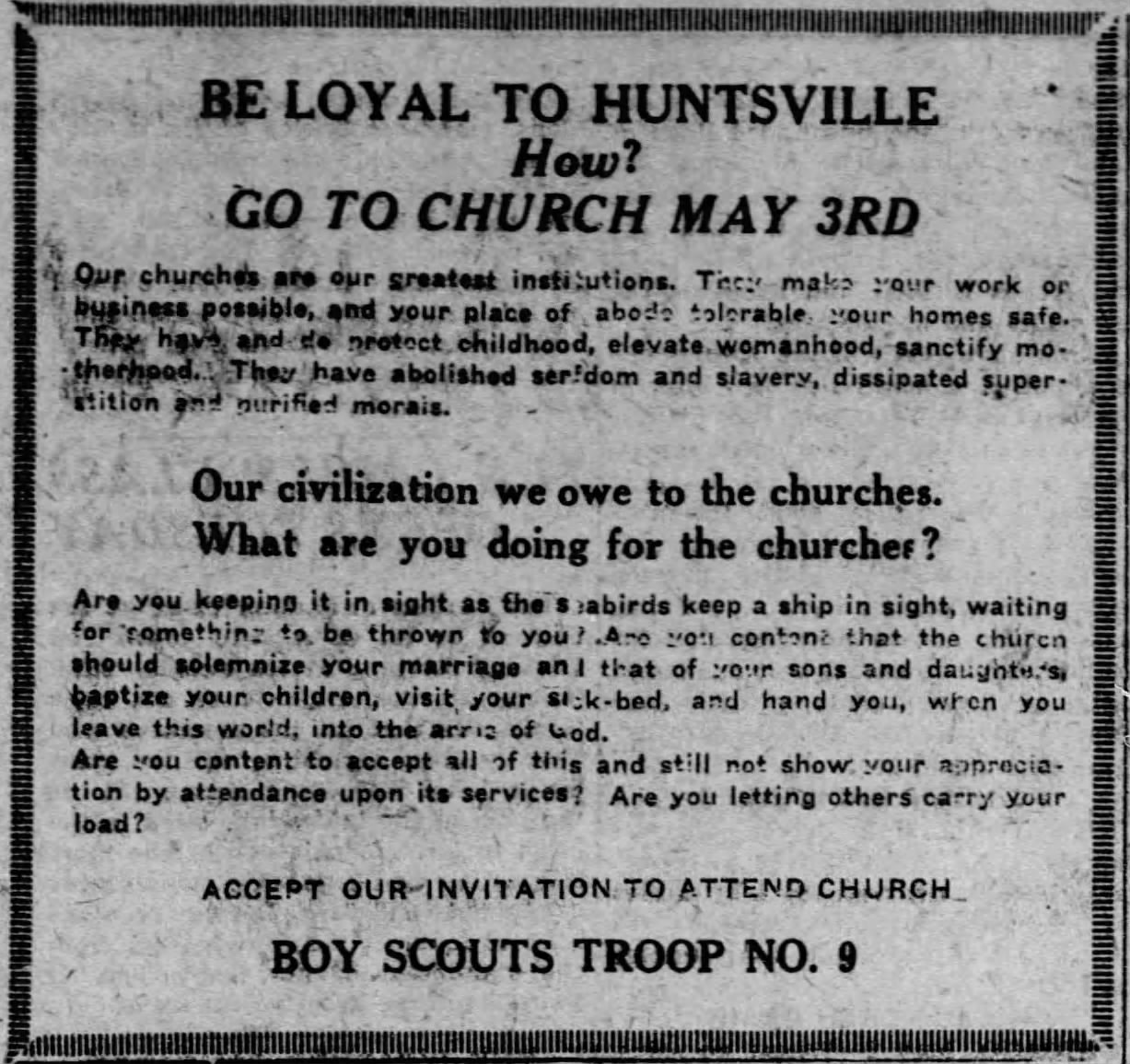

‘Loyalty Week’ invited comparisons between Huntsville and those parts of the United States that boomed. Opinion pieces chalked up the success of California in attracting outside investors, tourists, and developers to the extremely loyal and tight knit Anglo population that ran the state. Real estate developers snubbed the land rush in Florida and instructed hopeful investors to sink all their money into Madison county. There were predictions that Huntsville’s municipal bonds would soon become some of the most coveted financial instruments in the United States. Many of these pronouncements relied on Huntsville’s natural splendor and some of the earliest calls to transform the area around the Big Spring into a public park stemmed directly from the loyalty campaign. It proved successful enough that phrase “Be Loyal to Huntsville” appeared sporadically in local newspapers until the end of the decade.8
But far and away the greatest predictor of loyalty lay in how one used their pocket book. A May 1925 ad from the Retail Credit Bureau minced no words. One could only truly be loyal to the city by “trading with hometown merchants.” Merchants further afield had no long term interest in the city or its people. They did not contribute to charities or fund public institutions like the fire department or police. Huntsville’s resident elites relied on a paternalistic understanding of city politics and zero-sum growth to appeal to the masses. Wealthy merchants and business owners from other regions would only try to enrich themselves and their hometowns while simultaneously impoverishing Huntsville. Trading with outsiders was tantamount to treason.9

In an effort to draw a direct line between their shops and the continued well-being of the city, merchants featured the “Be Loyal to Huntsville” slogan heavily in their advertising. Hometown pride helped push everything from pianos and insurance policies to less grandiose items like brooms.

The celebration was not always so obviously mercantile. Contests and prizes abounded. In an effort to help foster “sincere reverence” for the city and its resident elites, school children wrote essays in exchange for gold, churches tracked attendance in hopes of winning a new vacuum cleaner. Civic organizations competed to raise funds (and perform good works) in exchange for high status items like loving cups, lawn mowers, and silk flags.10
Winning essays found their way into local papers and their contents help highlight how completely the loyalty campaign had seeped into both the local imagination and the minds of children. Cecil Brendle, a student at Huntsville High School, worried that without unwavering support the city government might falter and the city would become a “refuge for criminals” before eventually fading into disrepair and obscurity.11 Another winner declared that “to know Huntsville it love it… to Huntsville you owe your existence” and told anyone who might question or criticize city leaders that they should “get out or get in line.”12
Huntsville was not unique in advertising itself to the outside world, nor was it uncommon for merchants appeal to residents and citizens to shop local. Where it differed from so many other cities was in its concerted (and manic) efforts to not only inspire loyalty in the citizenry but publicly demand it. Between May 3-9, 1925 people allowed themselves to be gripped by a patriotic fervor and booster ethos that few places could replicate then and almost nowhere could replicate today. This fervor was stoked by a powerful and interconnected band of resident elites who wholeheartedly believed in the promise of both the New South and the Progressive era and hoped to use the associated ideologies to shape an ever-grander city.
Citations
Links:
“Before Folding 30 Years Ago, the Sears Catalog Sold Some Surprising Products” https://www.smithsonianmag.com/innovation/before-folding-30-years-ago-the-sears-catalog-sold-some-surprising-products-180981504/
“City Beautiful movement” at Wikipedia. https://en.wikipedia.org/wiki/City_Beautiful_movement
“Good Roads Movement” at Encyclopedia of Alabama. encyclopediaofalabama.org/article/good-roads-movement/
“Getting Out of the Mud: The Alabama Good Roads Movement and Highway Administration, 1898-1928.” http://www.uapress.ua.edu/9780817360603/getting-out-of-the-mud/
“Loving Cup” at Encyclopedia Brittanica. https://www.britannica.com/topic/loving-cup
“New South” at Wikipedia. https://en.wikipedia.org/wiki/New_South
searsarchives.com/homes/
searshouses.com
searshomes.org
“The Bizarre Story of Piggly Wiggly, the first self-service grocery store” at Smithsonian Magazine. https://www.smithsonianmag.com/smart-news/bizarre-story-piggly-wiggly-first-self-service-grocery-store-180964708/
“The New South” at Khan Academy. https://www.khanacademy.org/humanities/us-history/the-gilded-age/south-after-civil-war/a/the-new-south
Footnotes:
- “Loyalty to our Home Merchants – Another Out of Town Merchant’s Advertising Order Declined”
The Huntsville Times Nov 19, 1923 ↩︎ - “Huntsville’s Big Opportunity” The Huntsville Times March 30, 1913; “All as one for Mr. Wilson” The Huntsville Times Feb 13, 1917 ↩︎
- “All Aboard For Prosperity via Greater Huntsville.” The Huntsville Times June 29, 1924 ↩︎
- “Talking It Over – Chamber of Commerce Activities.” The Huntsville Times March 8, 1925 ↩︎
- “Talking It Over – Chamber of Commerce Activities.” The Huntsville Times March 23, 1925 ↩︎
- “Be Loyal to Huntsville – Week in May will be Devoted to Impressing all with that Idea.” The Huntsville Times March 25, 1925 ↩︎
- “Baseball Meeting is Called for Next Friday Night.” The Huntsville Times May 4, 1925; “The Building of Greater Huntsville” The Huntsville Times March 27, 1925; “Be Loyal to Huntsville. How? Go to church.” The Huntsville Times May 3, 1925; “Loyalty Week Has Begun and is Being Observed.” The Huntsville Times May 4, 1925; The scant mentions of Black participation should not be taken as lack of enthusiasm. White newspaper owners often engaged in direct erasure of Black social life and, when they bothered to report on it at all, offered mostly paternalistic reports. ↩︎
- “Be Loyal to Huntsville Week” by A.M. Duffield The Huntsville Times April 14, 1925; “Party Returns from Florida.” The Huntsville Times July 26, 1925; “The Loyalty Campaign is Working Wonders” The Huntsville Times May 5, 1925; “You’re in the Army Now.” The Huntsville Times May 2, 1927 ↩︎
- “Retail Credit Bureau Ad.” The Huntsville Times May 4, 1925 ↩︎
- “Be Loyal to Huntsville – Huntsville Has Been Loyal to You.” The Huntsville Times April 5, 1925. ↩︎
- “Talking It Over – School Children Essays.” The Huntsville Times May 20, 1925. ↩︎
- “Talking It Over – School Children Essays.” The Huntsville Times May 17, 1925. ↩︎
 huntsvillain