Based Keelboat

Littleberry Adams arrived in the Tennessee Valley a comparatively wealthy man. With seventeen enslaved people in 1809, he and his family easily ranked as the wealthiest members of local white society. Had the Broad River planters not arrived in larger numbers later that year then the Adams family might have kept their position at the top of the local hierarchy.

Due to this affluence, and associated early influence, Littleberry Adams, sometimes known as Little B. in court documents, deserves mention in any early history of Madison county. As such, Daniel S. Dupre makes quick reference to Adams as an example of a successful early squatter in his fantastic book Transforming the Cotton Frontier: Madison County, Alabama, 1800-1840. 

Dupre briefly alights upon both Adams’ role as an enslaver of people and early entrepreneur before moving forward with his discussion of north Alabama history. In his citations for the book he references an early court case in Madison county, where in 1810 a man named Robert Beaty sued Adams over delinquent payments for a keelboat with which to haul cotton. Although glossed over in Dupre’s account this case is as informative as it is hilarious; as it highlights not only the cash poor frontier economy of the territorial period but the role of equity and common law in early Alabama legal history.

On January 10, 1810, Little B. and Robert Beaty* met at “Dittoes Landing” to sign a contract for “one Keelboat, six polls, four oars, one hammer, [and] one corking chisel all in good order,” for either $120 or $220, depending on who you asked, in increments of fifty cents a day between January 10 and April 1, followed by the rest of the payment upon Adams’ return from the Texan cotton markets.

However, this is where the dispute arose. For although the contract itself mentions the $120, Beaty contended that they made it “in great hast at the boat landing” and that $220 remained the original price agreed upon by all parties. Beaty produced a man named David Thompson, mentioned as the original witness to the contract, who confirmed this differing price.

Adams not only neglected to pay the difference but had gone a solid year since that contract without paying Beaty any of the aforementioned money for the keelboat. As such, Beaty turned not to the common law, which would discount the oral testimony of David Thompson, but towards the newly established courts of equity where his case might be tried “in tender consideration… [for] mattes of fraud, deception, and such mistakes are properly cognizable and relieveable.”**

Both men mustered their attorneys and exchanged barbs over their contract. Littleberry Adams contended that their original contract was “informal” at best and not a binding covenant. While Beaty railed against his non-payment. Finally, in March of 1812, Adams admitted that the original verbal contract stipulated that he pay Beaty $220 for the keelboat.

Yet he still claimed that he ought not pay the total amount. Adams knew that the oral testimony of witnesses doomed him to a lighter wallet, so he decided that everyone should go down with him. He claimed that the boat was faulty and “in consequence of its leakiness the defendant was detained considerable time on the river.” By the time that Adams reached his destination, which appeared to be the Sabine River – a neutral territory between the United States and Spanish America that now forms the border between Texas and Louisiana, the boat began sinking again and he paid two dollars and “a considerable quantity of whiskey,” to have it both caulked and “laid high and dry,” during the repair process.

Littleberry Adams considered the associated expenses sufficient as the Neutral Ground, the territory around the Sabine River, existed as a haven for outlaws and bandits, and any time not spent on the relative safety of the boat probably exposed his small cotton shipping expedition to these dangers. Due to Beaty’s negligence, Adams found no reason to pay him the full price, or really any money at all.

Obviously this argument failed to hold up and Obadiah Jones, that lonely frontier judge, declared that Little B. owed The Beat $220 for the boat and an extra $22 for the court costs.

citation:

Robert Beaty v. Littleberry Adams, Book A, 1-3 (1811)

*Who I desperately want to refer to as The Beat.

**This is legitimately like the first court case ever prosecuted in Madison county, so Beaty is going out on a limb here.

Yazoo! Or creating Alabama for one and a half cents an acre.

On January 7, 1795, George Mathews – then the governor of Georgia – signed into law a “great cancerous abomination.” With the stroke of a pen, Mathews not only doomed his own political career, but touched off a contentious spark that ultimately resolved itself in the creation of two states, a Supreme Court case, and the cession of all of Georgia’s western domains.

I speak of course of the Yazoo Land Fraud. This update lies a little bit outside the blog’s usual domains – humorous accounts from north Alabama history – and instead ventures into something more macro in scope, the creation of the Mississippi Territory from Georgia’s western claims.

After the end of the Revolutionary War in 1783, it soon became apparent that many states claimed large portions of their neighbors; or that overlapping claims to various frontiers threatened to tear apart the tentative cooperation and coherence of the young republic.

western_lands_ceded_by_states
Courtesy of US History Maps

Most of the land in the United States during the Revolutionary War and afterwards in 1783 consisted of these aforementioned overlapping claims. For instance, both New Hampshire and New York claimed the modern state of Vermont, and both willingly ceded this land to the federal government – allowing Vermont to enter the union as a state in 1791. However, one state refused to give up its trans-Appalachian territories. A single state saw the sweeping tide of land reform and simply shrugged. *

That state was Georgia.

Georgia complicated matters not just with its mulish insistence that the original colonial charter, a document from 1732 granting Georgia lands all the way to the Pacific Ocean, be honored by the new nation. No, that would be too simple for the 18th century; instead Georgia’s western claims overlapped not just with South Carolina but also the Spanish Empire.

GeorgiaBoundaries1783-1795
Courtesy of GeorgiaInfo 

Thus any settlement of these claims prior to the 1796 Treaty of San Lorenzo, which solved the territorial and trade issues between the United States and Spanish America, carried with it no less than the prospect of provocation and potential war with a foreign nation.

Now Georgia, as the spiritual antecedent of the Deep South, acted with the according amounts of diplomacy and restraint on this issue by immediately establishing a short-lived county on the banks of the Mississippi River.

Bourbon county, Georgia, existed from 1785-1788, and served little purpose other than to upset the local Spanish governors and prove a drain on resources. Although the Georgia legislature rescinded Bourbon county’s charter after only three years of settlement; the site eventually became Natchez, the capital of the Mississippi Territory, in 1798. After the failed Bourbon county business other Americans soon took an interest in speculating about Georgia’s western lands.***

In 1789, the Georgia legislature attempted to sell its western territory to various land speculation companies for around $200,000. Unfortunately these companies only possessed the nearly worthless Continental currency circulated by various states during the American Revolution and Georgia only wanted to see that cold hard gold.**

Not until 1795, did Georgian legislators make their third attempt to sell massive amounts of land in exchange for bribes whilst simultaneously setting the stage to spark a border war with Spain. The 1795 sale effectively surrendered most of modern Alabama and Mississippi for about $500,000.00, or about a cent and a half an acre. Although a treaty of friendship between the United States and Spain soon emerged, and the disputed territories ceded to the United States, news of the treachery in Augusta soon trickled down to the rest of the state.

Which is when the entire state of Georgia lost its collective shit.

Upon hearing of the Yazoo Fraud, James Jackson, then serving as a Senator from Georgia – immediately resigned his position in the United States Congress, left Philadelphia, traveled back to Georgia, and got elected a member of the Georgia state legislature running entirely on an anti-Yazoo land sales campaign.

The Yazoo conspirators failed to take into account that 1796 was an election year and after the ink dried on the ballots almost none of them remained in office. The Georgia state legislature, and newly elected governor Jared Irwin, set about righting these tremendous wrongs. They cancelled all the original land sales, and accepted some cash help from the government in paying off the incurred debts.

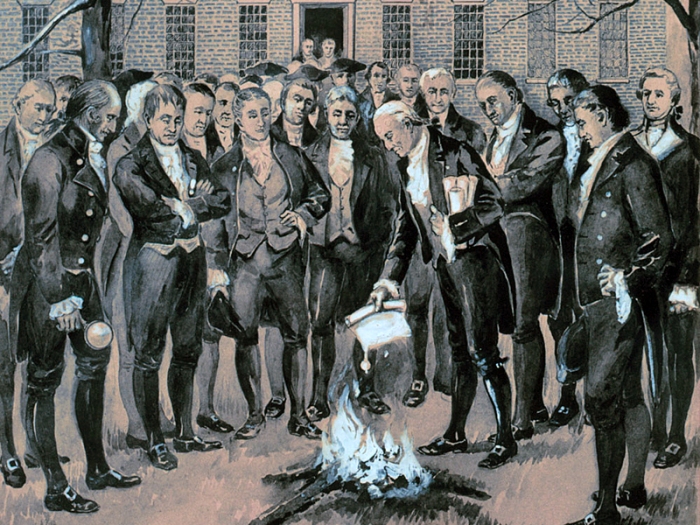
These efforts culminated in a symbolic burning of every copy of the original act enabling Yazoo land sales. The Yazoo Fraud entered the popular imagination of Georgians young and old, and the heroics of the anti-Yazoo crusaders and associated duplicity of the Yazoo speculators began to grow in scale with every retelling.

Absalom Chappell, in his 1874 text about the history of Georgia, recounts a story about James Jackson, the aforementioned former Senator, burning the first copy of the Yazoo Act “with fire drawn from heaven… by a sun-glass.” Although Chappell’s history tends to rely heavily on dramatic wording, for example his insistence on referring to the Mississippi River as the Father of Floods, there’s a level of ingrained cultural hatred that must be obtained before a popular myth recounts how a man literally used the fires of heaven to destroy a document. This is not mere hyperbole and grandstanding, this is a great example of how much everyone in Georgia hated the Yazoo sales.

yazoo burning
Burning the Yazoo Act. Courtesy of Georgia Encyclopedia

Unfortunately, many of the speculators already sold their claims to other buyers. This compounded the problem and resulted in several layers of claimants, many of whom refused to accept a buyback scheme and insisted on Georgia giving up the loot. In an effort to resolve the claims, Georgia ceded much of the land originally contested in the Yazoo fraud to the federal government, which organized the most southern portions of it into the Mississippi Territory.

Of course, not all of the land originally sold to speculators resided inside the newly minted territory, and people sued the state until Georgia completely washed its hands of the affair with the Compact of 1802, an agreement finally delineating the Georgia border and adding the remainder of the former western lands to the Mississippi Territory.

Eventually the Supreme Court handled the matter with the decision of Fletcher v. Peck in 1810, which ruled the 1796 cancellation of Yazoo land sales unconstitutional; thereby setting the precedent that federal courts might strike down state laws.

Had Georgia simply waited another year, or been more open in its speculation process, then the Yazoo Fraud would not have occurred and this blog might have a much dumber name – something like “Wacky West Georgian Tales” springs to mind. Instead, the shortsighted greed of a few not only reshaped Georgia state politics, but effectively birthed both Alabama and Mississippi and laid the conceptual framework for greater federal involvement in local legal processes.

Yazoo y’all.

*Although I’ve always been curious how Connecticut intended to enforce its territorial claims to parts of modern day Ohio.

**Fun fact, the Virginia Yazoo Company was headed by Patrick Henry, the “give me liberty or give me death,” guy. Which is kind of nice.

***Funner fact, one of these speculators was James Wilson. Who, to my knowledge, is the only Supreme Court justice to be imprisoned. He failed to pay his debts after getting involved in another land speculation scheme and spent a few years chilling in debtors’ prison, while remaining a justice of the highest court in the land, because the Early Republic was a crazy place.

Susannah Don’t Give a Ship

In 1802, the first Anglo-American settlers arrived in Madison county. The Ditto family came around the Great Bend of the Tennessee River and settled on what was either federal or Chickasaw land, depending on who you asked.

Not that the distinction mattered too much, as the Chickasaw Nation suffered from a long history of Anglophilia. After the Choctaw, a neighbor and regional foe, made alliances with the French, it quickly became advantageous to side with the British in all things. Following the American Revolution this quickly translated into a friendly relationship with the nascent United States. It unfortunately ended with the cession of Chickasaw lands in western Tennessee, northern Alabama, and eastern Mississippi and exile to Oklahoma – where the Chickasaw Nation found itself sharing land and resources with the Choctaw Nation, for administrative convenience.*

So when James and Jane Ditto settled on an island in the middle of the Tennessee River they found themselves surrounded by rough terrain and kind people. Originally from Baltimore county, Maryland; James Ditto eventually married a woman named Jane in North Carolina around 1775.

By the time they made it to Alabama, James Ditto found himself pushing sixty and too old for most professions. So he established a trading post and a ferry service that rapidly became a hub for north Alabama’s transportation and burgeoning commerce.

American colonists relied on the Ditto family’s boats and close ties with the Chickasaw Nation to ensure safe passage in the newly opened lands to the south. Ditto even ferried portions of Andrew Jackson’s army across the Tennessee river during the War of 1812. Eventually the outpost grew and in 1824, a salt trader and plantation owner from Virginia named James White expanded Ditto Landing into a port city named Whitesburg. The city eventually faded away before being absorbed by Huntsville in 1905.**

However, this is not really the story of Ditto Landing, nor is it the tale of James Ditto. Instead we shall focus on his second daughter, Susannah Ditto, and her brief marriage to Joseph Anderson.

August 27, 1806, saw what was probably the first American marriage in Madison county. A seventeen year old Susannah Ditto became the first bride. She lived for four years among the Chickasaw Nation. She, and her seven other siblings, helped her parents run the trading post. They were wild people, squatting on land and worried about money, and now she was married. The prospect failed to excite her for long.

On February 23, 1810, Susannah decided that she preferred Ditto to Anderson and went back to her father’s home on the river. Joseph Anderson waited the prerequisite number of years to file for a divorce and in 1813 presented his claims to the court.

She no longer loved him and refused to live with him while she drew breath. Since her departure several men “seduced” her and she “committed adultery with divers persons.”

Susannah replied to the allegations almost immediately. Surprisingly, she agreed with everything. The court could not fathom this. Why would a young woman, only 22 years old, admit to running around with all sorts of men and leaving her husband?

As the daughter of an infrequent pioneer, Susannah grew up on one frontier after another, she had little use for the civilization that so slowly crept into the Tennessee Valley, and as such felt no great compulsion to lie or cast herself as a faithful, if spurned, maiden. She was a Ditto, the first Anglo-Americans on the land. Everyone else was trespassing in her county. However, the judge, Obadiah Jones, saw in her reply not honesty but a woman manipulated by her husband.

He accused the couple of collusion and barred their chance at divorce. They remained married the rest of their days.

citation:

Joseph Anderson v. Susannah Anderson, Book A, 12-13 (1813)

*Which would be similar to forcing British and French people to live together because a bureaucrat from Bangladesh couldn’t tell the difference between them. Also, fun fact, during the American civil war the Chickasaw finally fought against the United States – marking the first time the nation ever raised a rifle at an English speaking state.

**One of my favorite tropes from north Alabama history is:

1) poor white settler from Tennessee or North Carolina squats on land

2) other English speaking people start to refer to that geographic feature as “someone-ville” or “specific human-point”

3) rich person from Virginia buys it and names it after themselves or a place where their family is from

4) other poor white settlers from Tennessee or North Carolina wait for rich Virginian to die before renaming it

5) poor white person enters communal history and memory

6) rich Virginian occasionally included as an afterthought, in this exact case as a street name.


Walter is Coming

On March 6, 1891, Louanna Harris Cagle gave birth to a prophet.

Her son worked a farm in Mountainboro, Alabama, a forgotten city absorbed by Boaz in 2009. Walt Cagle knew the weather. His predictions were often accurate, if not precise, and his arrival in Boaz for winter shopping a joyous occasion.

Cagle claimed that he watched the chipmunks and squirrels. He stared into the trees for hours and noted where they buried their acorns, he knew the size and frequency of each stash. The patterns of the little forest animals told him all he needed about the coming months.

People drove from far and wide to see the man. They made the trek from all over Alabama, from eastern Tennessee, and from as far afield as Atlanta to hear his predictions. Stores opened early and closed late on the day he planned to arrive. It could snow and gust and the sky might lob hail all it wanted, but Sand Mountain knew that winter started when Walt Cagle picked up his pants.

Walt Cagle Tuscaloosa News December 1936.png
Walt Cagle holding Boaz city keys. The Tuscaloosa News; December 2, 1936.

For you see, Walt Cagle ate twenty biscuits a day.

Often described as a giant, he stood 6’2″ tall and weighed in at over five hundred pounds. He dwarfed almost every other man in Depression-era Alabama. As such, no garment mill in the state could fill his clothing orders. Instead a tailor named S.H. Leeth fashioned pants and ordered 24 yards of flannel every August that his unfortunate yet aptly named wife, Minnie J. Cagle, fashioned into heavy winter underwear.

Although Cagle came to Boaz to pick up his annual set of pants for most of his adult life, he remained a regional phenomenon until 1935, when the city began celebrating “Walt Cagle Day,” to kick off the winter season. Suddenly newspapers from around the nation found his story enthralling and by 1937, he received fan mail from every corner of America. Several circuses tried to entice him to join their retinue as a special exhibit and a museum even requested a used pair of his flannel underwear.

On June 29, 1938, Walt Cagle died. A mortician from Albertville offered to design his coffin, taller and wider than any before it. Sixteen men carried Cagle to his final resting place – the Thrasher Cemetery in Mountainboro.

Winter has surprised north Alabama every year since.

citation:

“Big Walt Cagle Sees His Fan Mail Pour In.” The Tuscaloosa News (Tuscaloosa, AL), January 19, 1937.

“Boaz Prepares to Greet Cagle.” The Tuscaloosa News (Tuscaloosa, AL), December 1, 1936.

“Cagle Descends From Mountain.” The Tuscaloosa News (Tuscaloosa, AL), December 2, 1936.

“Huge Weather Prophet Honored by Villagers.” The Evening Independent (St. Petersburg, FL), December 3, 1936.

“Sixteen Pallbearers To Carry Walt Cagle.” The Tuscaloosa News (Tuscaloosa, AL), June 30, 1938.

“Walt Cagle, 550-Pound Weather Prophet, Dies.”  The Tuscaloosa News (Tuscaloosa, AL), June 29, 1938.

“Walt Cagle’s Around the Mountain, Winter’s Official in North Alabama.” Pittsburgh Post-Gazette (Pittsburgh, PA), December 19, 1935.

“Walt is Ready for Winter Now.” Herald-Journal (Spartanburg, SC), December 19, 1935.

“Winter and Walt Breeze into Boaz.” The Tuscaloosa News (Tuscaloosa, AL), December 18, 1935.


Oh Henry! The Long Divorce of Emiline Coleman, Part Five

Part 1

Part 2

Part 3

Part 4

Part 5: “…we should seize Riley”

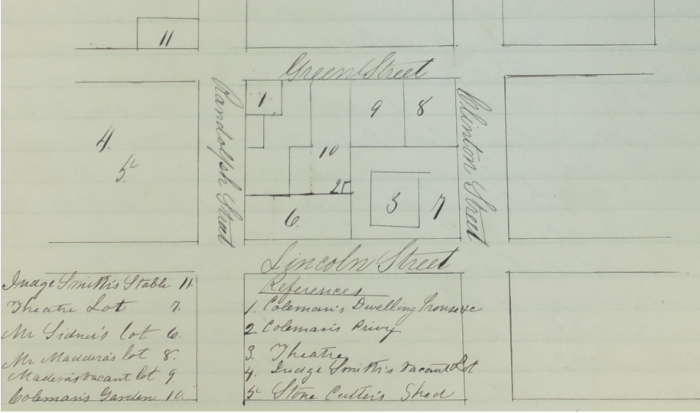
Judge Smith owned land all around Huntsville’s downtown. He rented his shed on Randolph Street to the stonemason William Edwards and both John Lewis and Preston Yeatman used the judge’s “large brick stable [on Green Street]… as a salthouse.” Both locations provided perfect vantage points for surveillance of the Coleman property.

coleman edits
Emiline and Henry are terrible at subterfuge.

Normally such surveillance might include mundanities like: John Coleman on a horse, Emiline Coleman drinking tea, or someone reading a book.

However, on Sunday, September 10, 1836, William Edwards noticed something different. His shed, “being on much higher ground than any part of said Coleman’s premises,” overlooked all of Randolph Street and allowed Edwards a view down into the Theatre on clear days. Around three or four in the afternoon, “during the continuance service of the Methodist Church,” he saw Emiline Coleman slip from the main house and down into the privy. Scarcely a moment later Henry Riley, “crossed the fence into the complainants garden and went into the same privy or necessary house.”

Apparently this happened often, as Edwards noted that “on divers occasions I had watched the maneuvers of Mrs Coleman and this man Riley,” which included the adulterous conspirators leaving notes for each other in fence posts and the aforementioned outhouse rendezvouses. William Edwards returned to his work but noted that not long after the two began their privy shenanigans; John Coleman rode up on a horse and, unable to find his wife or assuming that she went to church, began reading a book by the window.

Edwards ran into Henry Riley not long after this near “Mr Sydne’s Lot” (number 6 on the map) and spoke with him briefly about his time in the toilet. No reliable account exists of this encounter, but it appears that Edwards’ casual snooping entered the rumor mill and produced well hewn gossip about Emiline Coleman’s impropriety.

Such gossip died down, though never fully evaporated, following the departure of Riley’s acting troupe. However, his reappearance in early December ignited a flurry of activity, both among people who liked talking, and between himself and Emiline Coleman. More conspicuous than his reappearance was the fact that he was “unaccompanied by the residue of the Company and without any ostensible business.”

Henry came to see Emiline.

Preston Yeatman noticed his sudden reemergence and felt compelled to track the actor all over Huntsville. So when Yeatman, and his associate John Lewis, noticed Riley hovering beneath a window – they paid attention.

Around two p.m. on Saturday, December 17th, 1836, the two men quit unloading salt from a wagon as Henry Riley walked up the street and instead ran inside Judge Smith’s stable and watched intently through the grates. The solid brick structure hid them as “the window blinds of a window on the second story… cautiously opened and a small piece of paper drop[ped] down at the feet of said Riley.” The actor cast several furtive glances around the street to make sure nobody watched him as he “picked up the paper and thrust it into the pocket of his pantaloons,” before scurrying off towards to the town square.

Preston Yeatman and John Lewis turned to look at each other and they said ‘oh dang, we should tell somebody.’

That somebody happened to be James W. McClung, a close associate of John Coleman and a man of hasty action. He knew of the rumors circulating about Emiline Coleman, a woman whom he described as “volatile and girlish,” and it appears he was none too fond of Riley either. Upon being informed of the paper dropping, McClung immediately found John Coleman. McClung formed an impromptu posse of himself, Coleman, Lewis, and Yeatman; who at McClung’s suggestion that “we should seize Riley and thus get possession of the paper,” set off for the town square.

Henry resisted their initial demands but the four men assaulted him and afterwards “forcibly examined the said Riley’s person.” They indeed found a letter in Riley’s pantaloons.

I am so much pleased to see you here once more but it is impossible for me to speak to you. I am still the same and ever shall be return home Henry and forget me if you please if it is ever in my power to become the Bride of H with honor I will, and as soon as I can you shall know it keep my secret if you please, never betray me so long as you live, write a letter this evening and tonight after tea slip it through the window blinds of the porch I will be there playing on the piano. Adieu Henry

Yours – Yours

Distraught at this plain evidence of Emiline’s affair, John returned to his work at the Land Office; where he spoke with his close friend Samuel Cruse. John remembered his sister, Narcissa, warning him of Emiline’s infidelity, but had ignored her and instead listened to Emiline’s tales. While he contemplated his next move the three other men ran Riley out of Huntsville, apparently he left so quickly that his luggage remained in town.

Samuel Cruse had an idea. He remembered that Henry Riley stayed at the Bell Tavern inn. So he accompanied John to the place, and after some misgivings from the owner, they barged their way into Riley’s room. There they found a large trunk, which they forced open. Among Riley’s clothes and baubles they found fifteen letters written to him by Emiline Coleman, as well as “a miniature of Mrs Coleman, which I recognized as a likeness of her.”

Samuel Cruse paid for a stage coach to take Emiline to her father’s home in Marengo county. John Coleman paid for a lawyer. On November 1, 1837, the court granted him a full divorce.

citation:

John J. Coleman vs. Emiline R. Coleman, Book J, 91-114 (1837).

Oh Henry! The Long Divorce of Emiline Coleman, Part Four

Part 4: Front Seats reserved for the Ladies 

Like most actors of the time Henry Riley made the rounds. Outside of the major cities on the eastern seaboard, very few people could make a living at a single theater due to either lack of interest by the locals or their general lack of funds. So nineteenth century actors formed an itinerant comity that traveled from one cottonopolis or boomtown to the next; a living marching recitation of Shakespeare, bawdy stories, and songs about cheese. That is to say – they carried high culture on their backs from end of America to the other.

Due to the lack of radio or other recording devices these actors often aped the styles of their more famous brethren. These fifty cent theater-mongers imitated the powerhouses of London, New York, and Philadelphia; perfecting their speech patterns and timing in the hope that one day somebody else would be mimicking theirs.

Henry Riley offered “celebrated imitations” of both male and female performers – including the recently deceased Edmund Kean as Richard III, the famously fainting Sarah Siddons as Lady Randolph from the tragedy Douglas, and of course Junius Brutus Booth, the father of Abraham Lincoln’s assassin, as Iago from Othello.

So when he came to town in the summer of 1836, it was kind of a big deal.

Arrangement were made to sell tickets to his performance, half a dollar apiece, at various hotels around the city. He offered a discount for children and claimed in his promotional pamphlets that he reserved the entire first row at every performance for various society ladies.

It was during this performance that he first made contact with Emiline Coleman. The young woman not only attended the event but apparently became smitten at Riley’s range and his beauty. One can only speculate that she fell madly in love with him by the first verse of “Butter and Cheese.”

The early days of the affair went well. Riley spent much time at the Theater and, fortunately enough for both involved, the Coleman’s house lay directly next to it.

Diagram p 6793
Map of Downtown Huntsville produced for this court case, 1837.

As one can see from the map, the Coleman’s outhouse lay directly next to, and probably drained into, the “Theatre Lot.” All Emiline needed to do was skip out into the garden and she might make an illicit rendezvous with Henry inside.

Although John J. Coleman eventually lost his wife to Henry Riley, the fact that he literally shit on the actor’s career every day provided some small measure of solace.

Part Five


Oh Henry! The Long Divorce of Emiline Coleman, Part Three

Part 3: Who is John Coleman?

On Christmas Eve of 1829, a man named John J. Coleman married Emiline R. Williams in Courtland, Alabama. They stood together in a Lawrence county church in front of his family and made solemn vows of chastity and devotion. She hailed from Marengo county, Alabama, some two hundred miles to the south. His people were slightly more local.

The Colemans first arrived in the Mississippi Territory in the fall of 1811, and “with the exception of occasional and temporary absences,” had resided in Huntsville ever since. People moved a lot during this era, after all, the newly depopulated southeastern frontiers weren’t going to settle themselves. So by the internal clock of most Anglo-American colonists, the Colemans were practically native to Madison county – seemingly sprouting from the primordial ooze of the Mississippi Territory and ossifying into a house off Randolph Street.

Although the Colemans didn’t travel much, John Coleman’s marriage to Emiline Williams occurred after seventeen months in Litchfield, Connecticut. He’d only arrived back in Alabama in the summer of 1828, and his bride-to-be was still a 13 or 14 year old girl some 200 miles away. There’s almost no way they had much prior communication and from the relative wealth of both families, coupled with their astounding age difference, it appears that an arranged marriage occurred.

Indeed, we know that John J. Coleman was much older than Emiline R. Williams when they married, not because it is mentioned that her age was 15, but because John traveled to Augusta, Georgia to conduct business for the family in 1816, and managed to stay there for about sixteen months. Now, assuming that he was only 16 or so when this happened (and that is a hell of an assumption because people were still considered legally ‘infants’ and thus unable to conduct most forms of business until the age of 21), then John J. Coleman was, at a minimum, about twice Emiline’s age when they married in 1829.

In order to woo his young bride he showered her with gifts. According to the testimony of Narcissa Coleman, just in 1836, he purchased “a Piano Forte which cost him $200 dollars, a Dressing Bureau which cost 100$, a Gold chain which cost him 75 Dollars, a pair of Gold Earings which cost him 35 Dollars besides a great number of valuable and expensive articles of Dress.”

John J. Coleman had all the money he could need but ultimately found himself unable to compete with a long legged actor from Nashville.

Part Four


Oh Henry! The Long Divorce of Emiline Coleman, Part Two

Part 2: Ann of Keen Fables 

During the strange and complex tale of Emiline Coleman’s affair with Henry Riley an unlikely actor emerged in the form of Ann. Although Ann is described only sparingly throughout the case of Coleman v. Coleman; her actions and agency ultimately serve as the catalyst that propels the divorce.

Due to Ann’s status as an enslaved young woman she is often referenced as an afterthought by the white protagonists. However, she gets a lot of screen time in comparison to other enslaved blacks in 1830’s court battles.

It appears that Ann served as Emiline Coleman’s handmaiden and gofer. She carried letters and acted as an occasional chaperon and sometimes confidant for the 22 year old married woman. Narcissa Coleman, Emiline’s sister-in-law, described Ann as “a negro Girl… about 13 or 14 years of age, worth at that time 800$ at least.” When Emiline’s husband, John Coleman, banished her from his household he sent Ann with her to Marengo County to continue her services.

However, the thing that made Ann an integral player in this melodrama was her betrayal of Emiline Coleman to her sisters-in-law. For several months she carried correspondence between Emiline and an actor from Nashville named Henry Riley.

Riley stayed at the Bell Tavern and spent weeks at a time in the city performing at different theaters. It would be inappropriate for Emiline to spend so much time around Henry without her husband. By sending an enslaved person, she circumvented this social norm and managed to communicate to her heart’s desire.

It appears that higher class white women in Huntsville all used some form of this system. Often cloistered in their homes they needed to develop what amounted to personal spy-rings to both stay abreast of news in the city and exercise a measure of influence. We know that Narcissa and Delia Coleman suspected Emiline of infidelity as early as September 9, 1836, some 11 days before she wrote Exhibit J. Both women mentioned that “reports were whispered about amongst the negroes to the discredit of [Emiline],” and that they began turning their attention towards Emiline’s business, and by extension, the comings and goings of Ann.

It appears that Ann either communicated the purpose of her errands to enslaved people attached to Narcissa Coleman’s household, that they spoke to her, or she noticed their presence. Either way, Narcissa learned why Ann went out so much and it appears that she instructed the young errand runner to bring her evidence of Emiline’s indiscretions.

Which she did.

Emiline wrote a letter to Henry Riley requesting he return a photo of her. Now this was most likely a small painting, but apparently it was highly prized her husband because he’d been inquiring about it for months. Emiline lied and said that a friend of hers named Mary Crampton borrowed it and had yet to give it back.

Instead of carrying it to Henry Riley, which she had done so many times before, Ann presented the letter to Narcissa Coleman and quickly left. This gave Narcissa the evidence she needed to begin whispering in her brother’s ear.

Part Three

Oh Henry! The Long Divorce of Emiline Coleman

Part 1: Exhibit J

Huntsville Ala. September 20th, 1836

Dear Henry,

Do not trouble yourself any longer about me I always knew I was born to meet trouble and see disappointment. Therefore I will be content though not happy, to obliterate my name from your heart, never more think of me.

The night you were in the garden Mr. C sayd I must have known you were there though he does not know who it was, but I stayed so very long when I went there before you came I had just gone to the house as he started down there. I called him I thought if you were there you would hear me and go away.

That was the only reason [I] called him the minute he came in the house he sayd I must have known who you were, he for the first time in his life spoke unkind to me I did not say a word to him, he asked me two or three times who you was but I would not tell him, he sayd if I did not tell him who it was I might go my way and he would his and he sayd a great many other things but he saw I would not say any thing, he came to bed I thought at one time I would tell him all and go to your to protect me but I thought it might lead to death and probably yours, then what would have become of me?

I would have no one to go too all that cept me from it was on your account Henry, wait a year or two, then perhaps we may be united with honor.

The night after you let here I dreamed I was lost in the most beautiful forest I ever saw. I was walking in a little path and I came to a beautiful spring and by the side of it lay a little boy asleep, he was about three or four years of age he was the most beautiful child I thought that ever was, his hair as glossy as it could be and his cheeks like roses. I touched him and he asked me who I was, I told him my name then I asked him his he sayd he could not tell me, he told me if I would go with him he would give shelter in his fathers ship he would not tell me who his father was, and I asked myself if any so heavenly as this little boy could do me harm. I thought not.

The vessel lay at anchor in a Lake it was the most beautiful ship that ever was made, the sail was of sky blue silk, he unfurled the sail and it sett off at full speed, it was on the most beautiful water I ever saw, the form of the ship reflected in it like a mirror, it was intirely unruffled, it was as calm as though some fairy floated o’er it. Though it did not last long, a cloud arouse in the west, the wind blew very hard, the lightnings flashed the thunders rowled and the ship struck a rock and it was about to reck, the little boy clasped me around my neck and asked me if I would protect him.

I told him I would while Life last. I asked him then who was his father and he said “Henry Riley is my Father.” Great Heavens how I felt I can not describe when I felt myself clasped in your arms, for at that moment you stept on board of the ship I knew not how you got on board. I asked you how you came there your answer was you came to save us and the vessel did not sink. I was so much frightened that it waked me and I got up and felt about to see if it was a dream or not, no one was in the room with me Mr. C was in the country, I was mad it was a dream, if there is any thing in dreams how will you interpret this? Why I will tell you how I interpret it, some dreadful dishonor awaits me and you will save me from it just at the time I need protection most. I will not tire you any longer with my foolishness, write soon.

Adieu Henry. I have not been well since you left.

give my love to Sam

Yours E.R.C.

Part Two

Shamsprowe

In 1825, John Sprowe sent a letter from Natchitoches, Louisiana to a judge in Huntsville, Alabama. He thought of his youth and of his travels and tribulations. Mostly he thought of Elizabeth Sprowe.

William Ray stood before the happy couple. Rural Kentucky offered few priests to “solemnize the rites” and he stepped forward to fill the role “of his mere voluntary pleasure.” After all, it was 1799, he’d been to church before. You just say something about Jesus, gesture at the crowd, and nod slowly.

Besides, they needed some kind of parson to sanction their commitment of marital acts. “Well, I’m some kind of parson,”thought William Ray the non-parson, “and I mean, Hell, what could go wrong?”

Well, it was 1805 now, and the Sprowes committed enough marital acts between them to produce three children and a lot of fighting. They still lived in Cumberland county, Kentucky and often managed to agree that they married each other some six years prior. It made life easier.

Eventually, John Sprowe grew tired of his wife and using the technicality that “said Ray was not authorized to solemnize the marriage,” sought to find a new one. Although nineteenth-century states compensated for rural couples, incapable of formal ceremonies, with marriage provisions based on common law, he felt confident in his decision. So, one day Elizabeth Sprowe went to bed married and woke up abandoned.

Soon she received news of John’s infidelity. He’d shacked up with a woman named Rachel Davis and their life continued this way for several years. Elizabeth Sprowe cared for their children while John Sprowe lived on the other side of the county.

Apparently he visited his family to check on his property and children. Especially after he heard rumors that Elizabeth Sprowe no longer recognized their fake marriage. During one of his visits he found Elizabeth Sprowe with the silversmith John Steward.

John Sprowe found his sometimes-wife engaged in marital acts with someone that she was not occasionally married to and expressed outrage at her violation of their least sacred bond. He gathered his three children and departed.

Eventually Cumberland county, Kentucky proved too much for him and he left Rachel Davis and headed south for Alabama. Where he lived for some time, amassing considerable wealth. It appears that the couple reconciled enough for Elizabeth Sprowe to eventually make the trek to Madison county to join her children and common law husband.

According to a witness named Bird Brandon, by the time he remarried John Sprowe owned seven hundred acres of land and enslaved six or seven people. Unfortunately for Elizabeth Sprowe another woman benefited from his considerable holdings.

Although the Sprowes lived together as a married couple, off and on, since 1799, John Sprowe chose to legally marry Pamelia Brown on April 11, 1822.

All court records indicated that they still resided in the same household when the marriage occurred and that he left their children with her before moving into Pamelia Brown’s home. Shortly afterwards he sold the seven hundred acres and purchased land in Louisiana. Even in his 1825 deposition from Natchitoches, John Sprowe admitted that he wished to continue living with Elizabeth Sprowe so long as they were “not bound.” One wonders what Pamelia might have thought of that.

The court eventually dismissed Elizabeth Sprowe’s petition for a divorce. John Sprowe continued to reside in Louisiana. They probably moved back in together a few years later.

citation:

Elizabeth Sprowe v. John Sprowe, Book A, 40-42 (1822).