Situation Normal, Hall Fouled Up

In the spring of 1837, James Ragdale and Nathaniel Hall spoke briefly in front of Nathaniel’s house. Ragdale visited the Hall estate and witnessed Mary Hall and Nathaniel engaged in one of their epic quarrels. He’d only known the couple for a few months at this point but all who knew the Halls knew that the family relied on violence to communicate. They cussed each other out as Ragdale announced that he thought he should leave. Nathaniel escorted his guest outside and stood with his visitor. He looked the man in the eyes.

Without a word Nathaniel Hall began “unbuttoning his pantaloons.” Surely at this point James Ragdale felt unsure of himself. ‘How do I explain to the man that I’m not down with that?’ he probably thought. Yet Nathaniel Hall unbuttoned his pants not for gratification but to highlight his circumstance. James Ragdale saw a pistol tucked into his host’s undergarments, Hall moved those aside and gestured at an old wound.

Apparently Mary stabbed him in the crotch a few years ago. She narrowly missed the vital arteries of the leg but left a gaping reminder of her wrath. Hall desperately tried to explain. He carried a loaded pistol because he feared his sons might try to kill him. He and Mary lived in constant fear of each other. Their children felt only misery at their parent’s incessant feuding.

He planned to leave. Nathaniel Hall knew the law. Although he suspected that Mary Hall planned to sue him for a divorce, he also knew that they needed to live in separate houses for several years in order to go through with it. He planned to evacuate his youngest children to a new home he hoped to purchase with that year’s proceeds from his farm. He didn’t trust Mary Hall as she’d already left him once for a man named Martin Guest and probably performed further “illicit interviews” in the woods after she returned from her dalliance. Nathaniel’s brother lived about a mile away and he could stay there once the time to leave her came.

How did it come this far? The Halls married in either 1812 or 1816. Each spouse filed different divorce suits against the other and listed various dates. Both failed to list the place of their marriage. Context clues point to either an Alabama wedding or a migration here shortly after their marriage; Nathaniel Hall accrued several hundred acres in Madison county, lived near relatives, and the Halls had about ten children. So it seems likely that by the time they filed against each other in both 1838 and 1842 that they’d been living in or near Huntsville for about two decades.

Like many families their quips became quarrels and their quarrels became quotidian. People bound by blood and semen are bound to fight. Except this is Alabama and it is the 1830’s, so those fights quickly became violent.

On April 1, 1837, Nathaniel Hall pulled his pantaloons pistol on his wife. Their nineteen year old son Andrew Hall wrestled the gun from his father but Nathaniel screamed a dire warning before he retreated to his brother’s home.

He said “at some future day [he] would carry out his purpose when there was none to prevent.” Nathaniel Hall returned to their estate several times. He came once while his sons worked in the fields and confiscated all the guns he could find in their house. He reminded Mary that he “was well aimed with pistols & that he intended her time in this world should be very short.” It seems strange that he failed to murder her then but perhaps he feared the retribution of his nearby sons.

Mostly, it seems that Nathaniel Hall feared Andrew. Described several times as having “a week intellect,” Andrew Hall performed much of the most strenuous labor around the farm, especially since Nathaniel Hall sold three slaves upon leaving his household, and the boy possessed a massive strength and unwavering devotion to his mother. In fact, when Nathaniel returned a second time “to superintend some of his plantation affairs,” he learned of his failure to confiscate all of his family’s pistols.

Nathaniel Hall brought back up on his superintending visit. He wished to inspect ledgers and farmland after hearing rumors that Mary Hall “sold a large quantity of bacon which he had provided for his family and that she is permitting his stock of hogs and cattle to be wasted.” Instead he found Mary Hall and Andrew standing in the road. Mary Hall stood behind her son. Andrew Hall stood behind a pistol.

After a long silent moment Mary Hall spoke up. She threatened that Andrew Hall, “armed with a loaded pistol which presented in a shooting position,” would shoot his father and his friends if they attempted to enter the yard. Nathaniel Hall left without inspecting his herds.

He received the subpoena to appear in court. Soon after that any and all payments made to him by indebted men ceased because the court ordered a temporary halt to his business ventures. Mary Hall accused him of abandonment. He could easily cash in on his debts and leave for a different state. The court quickly dismissed the case with no word on alimony or the splitting of property. Although Nathaniel Hall resumed his business, Mary Hall and their terrifying sons remained at the main home and he worked from his brother’s house.

In 1842, Nathaniel Hall counter-sued for a divorce. He’d waited the correct number of years, hired a lawyer, and presented adequate evidence. Yet Mary Hall died soon after the beginning of the case. They were finally rid of each other.

citation:

Mary Hall v. Nathaniel Hall, Book K, 211-248 (1838).

Nathaniel Hall v. Polly Hall, Book L, 171-172 (1842).*

*a pseudonym, he explicitly mentions the previous case and that her given name is Mary
From Ticks to Terrorism, Cullman county

The certainty of dynamite briefly challenged the concepts of agricultural science and state law during the summer of 1919, as southern farmers reacted to new regulations designed to wipe out a variety of ticks, and the blood parasites they carried, with swift and disproportionate violence.*

Southern cattle suffered from these ticks and their blood parasites, but consistent low-grade infections meant that most developed a level of immunity as calves. Although the southern ‘cracker cattle’ grew up stunted and weaker, they still persevered. Whereas the ravages of tick-borne disease absolutely decimated northern and Midwestern herds.

Meat markets remained regional throughout much of American history. So although the earliest instance of these ticks nearly wiped out cattle in Georgia during the 1740’s, the surviving herds formed the nucleus of an isolated southern cattle industry. As Georgians brought their cattle westward into the Mississippi Territory the infected herds spread the ticks to other cattle encountered. Whole generations of cattle lived, died, and bred with these parasites plaguing their every moment. Indeed, by the eve of the American civil war, northerners traveling through the deep south often noted the stunted nature of indigenous cattle in comparison to what they assumed were heartier northern breeds.

Cattle drives from Texas to Kansas resumed after the war. However, for the first time, trains began to link these cattle drives to the massive stockyards of Illinois and other northern states. Wherever the southern cattle went death followed. Suddenly ninety to one-hundred percent of Midwestern herds perished within days or a few weeks of mixing with cattle from Texas and other parts of the south.

Obviously everyone panicked. By 1885, officials in Kansas banned Texas cattle** from even entering their state and the national cattle industry developed almost entirely without southern contribution. Indeed, by the early 1900’s almost every southern state felt the impact of federal quarantine on their cattle.

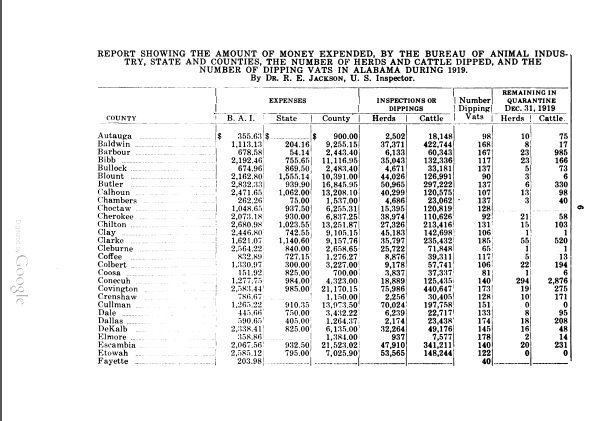
Which brings us to 1919. In February, Alabama lawmakers mandated the building of tick-vats and the dipping of every cow in the state in an effort to rid Alabama of the tick and finally participate fully in the national cattle industry. They followed the lead of Georgia and Mississippi, both of which instituted similar programs in 1906. Counties responded with a furious effort to build the required tick vats, gather herd information, and then process the hundreds of thousands of cattle around Alabama. They soon met stiff resistance.

via The 1919 Annual Report of the State Veterinarian, page 6.

The Cullman Democrat is the only surviving newspaper from 1919 in the Cullman county archives. Unfortunately it does not exist on microfilm nor did the original archivists preserve anything but the Thursday editions. Perhaps they were born on a Thursday, perhaps the kind of person that hoarded copies of the Cullman Democrat only made money on Thursdays, or the archivist took Fridays off. It’s a strange conundrum. Surely the Sunday edition would have been fuller and more expressive of the previous week? Oh well, what I’m saying here is that we can only glimpse the Cullman county of 1919 and are unable to fully explore its beautiful and dynamite ridden depths.

However, some interesting things emerged. April 1919, saw the greatest rebellion in Cullman county against the tick vats. Farmers dynamited vats at Sulphur Springs, Holly Pond, and Brooklyn. A man named Charlie Bishop blew up the Sulphur Springs dipping vat on Friday, April 11, 1919. He failed to finish his work and probably proved the most inept overall. Bishop proved unable to destroy the vat even though he used at least two sticks of dynamite. His trial began on April 19, 1919 and continued through July. Although the Cullman county archives maintained a healthy selection of old court cases I failed to find his conviction.***

After this spate of explosions the sheriff used bloodhounds to try and track down the perpetrators. The county employed armed men to protect the vats at night. Yet this did not halt the range war. On April 18, J.A. Harbison and Monroe Phillips guarded the repaired Sulphur Springs vat. As the daylight died they readied themselves for the near certain attempt to finish it off. They reported seeing “two men stealing up towards the vat.” One carried several sticks of dynamite while the other held “a coal of fire.” The targeting of Sulphur Springs, of the 151 vats in Cullman county alone, suggests that the men were either associates of Charlie Bishop or heard of the previous attempt and viewed this particular vat as a high profile target.

The would-be dynamiters failed to see the guards and kept advancing. J.A. Harbison proved close enough to get a good shot and opened fire on the man holding the “coal of fire.” Although he hit the man, both of the rebellious farmers managed to escape into the surrounding hollow and avoided arrest. The Cullman Democrat mocks the historian here by mentioning that “this is the only attemp to blow up vats this week.” Soon after these attempts the farmers of the county tried to hide their cattle rather than explode the tick vats and mentions of dynamite soon fade from the record. I plan to further explore this phenomenon in parts of Alabama where nobody has ever thrown away anything – like Madison county. Until then, remember this, faced with a reasonable request the people of Alabama chose stubbornness and violence. It’s almost endearing.

citation:

Haygood, Tamara Miner. “Cows, Ticks, and Disease: A Medical Interpretation of the Southern Cattle Industry.” The Journal of Southern History 52, no. 4 (1986): 551-564.

The Thirteenth Annual Report of the State Veterinarian of Alabama, 1919. Montgomery, Alabama: The Brown Printing Company, 1920.

“Dipping Vats Blown Up, Blood Hounds Ordered.” Cullman Democrat (Cullman, AL), April 17, 1919.

“Guards Shoot at Men Attempting to Blow Up Vat.” Cullman Democrat (Cullman, AL), April 24, 1919.

*a good/possibly only book on this subject is “Making Catfish Bait out of Government Boys: The Fight Against Cattle Ticks and the Transformation of the Yeoman South,” by Claire Strom. I came across while researching this blog post. I’d heard about the dynamiting of tick vats from an earlier work on the history of cattle farming in Alabama and was really bummed to discover that someone else wrote the first book on it. Oh well, I’ll write the second.

**and by extension cattle from the rest of the south, it made more sense to just sell your herd west than try to take them through Nashville and onward to the slaughterhouses in Chicago.

***although I found a bunch of homosexuality cases that mentioned the same guy over and over again. it’s almost like the sheriff camped out near Dick Wells’s house and arrested him every other time he engaged in man-on-man loving. fun fact, all the men he supposedly got it on with appeared as witnesses against him.

Love in the Time of Adequate Syphilis Testing


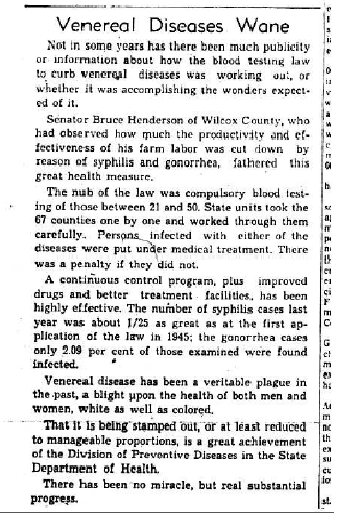
Alabama periodically reenters the news as a focal point for a new syphilis outbreak. Of course, the active cases are usually found in or around Birmingham, the state’s largest urban center and industrial hub. However, let us not forget a happier time, when an aggressive venereal disease control program worked wonders in rural Alabama, except for the areas around Tuskegee – for obvious reasons, and the initiative of the Alabama Department of Public Health helped preserve the quality and quantity of life for tens of thousands of people.

In August 1945, Bruce Henderson, the state Senator for Wilcox County, managed to get a bill passed which required testing and immediate treatment for everyone between the ages of 21 and 50. His sudden interest in controlling syphilis and gonorrhea stemmed not from a compassionate core but from his position as a plantation owner. Untreated venereal diseases absolutely wrecked anyone’s ability to do physical labor or otherwise participate in the state’s economy.

It took almost thirteen years of subsidized education, health, and prevention programs; but for a short time it appeared that major venereal disease might be wiped out throughout the state. Then funding stopped. Alabamians are a promiscuous people and soon reinfection rates outstripped previous control efforts. Which is how we’re at our current state of venereal epidemics every two or three years.

So remember sweetly the spring of 1958, when for a brief moment only 2.08 percent of the state’s entire population had gonorrhea.

via The Journal of California and Western Medicine, "Cal West Med. 1945 Aug; 63(2): 105
via The Journal of California and Western Medicine, “Cal West Med. 1945 Aug; 63(2): 105
via Huntsville Times
via Huntsville Times; February 2, 1958.

Definitely Not a UFO

Little research, or even cultural impact, followed this event. However, I’d like everyone to know that on February 11, 1958, the population of Huntsville freaked out about a possible UFO. Thousands of people then called the Huntsville Times to see if they’d set up an interview with the otherworldly visitors.

via The Huntsville Times

TRANSCRIPT FOR THE WEAK OF EYE:

“The “moons,” flying saucers and spaceships that amazed early-morning risers in this section of Alabama, and set off a number of inquiries to The Times, weren’t moon or saucers at all. It was an old friend, the Aurora Borealis – more familiarly known as the Northern Lights.

In this area the phenomenon lasted approximately from 5 to 6:45 am. The predominant hues here were reds.

The Associated Press reported that the display was brilliant in many parts of the nation. Skies glowed with bright red and pink hues, and in a few regions, with green and yellow colors.

Radio and TV transmissions and news Teletype wires were affected in the United States and Canada.

Observes in northwestern California saw bright red lights streaming over the top of a low cloud bank. The lights were reported later turned to white.*

The Northern Lights are caused by streams of particles shot out from the sun. Striking the earth’s high atmosphere, they excite atoms of air and cause them to glow.”

*arguably one of the worst sentences ever written.

The 1836 Jackson County Orgy

William Green married Elizabeth Brandon on December 13, 1835. They wed and lived in Jackson county, Alabama. According to William Green he did “everything in his power from his limited circumstances to make his home comfortable and a poor mans wife happy.” Elizabeth Green found little joy in eking out a sparse existence in one of north Alabama’s poorest counties.

Although William Green claimed to provide all these things, he soon learned that Elizabeth Green “about two years previously to this been delivered of a bastard child.” No further mention appeared of the child’s whereabouts or its sex. About three months after this revelation, around May 1836, William Green suspected “that her personal favours were lavished upon any person in his absence who might choose… to gratify themselves with her.” Her acts soon became notorious in the neighborhood and the subject of frequent gossip. Especially repeated visits from two men named Frazur and Childress.

He confronted her around September 1836. Elizabeth Green confessed to getting it on outside of marriage. Humiliated and confused by this seeming betrayal, William Green volunteered to join a company going to Florida to take part in the ongoing Seminole wars. Prior to his departure, William Green claimed to furnish his wife and home with whatever she might need during his sojourn in Florida, “hoping posibly by his kindness and generosity to her that she might probably repent and be reclaimed.”

He returned from Florida on May 28, 1837. Elizabeth Green failed to live up to his hopes. Wild rumors circulated of her conduct. Consistently he heard tales of her adultery, even a possible liaison with her sister’s husband. However, the worst news awaited him. Shortly after he left Elizabeth Green attended a “camp-meeting in the neighborhood [where] her conduct was that of a common prostitute, all who wished then and there had adulterous connexion with her and so open was she in it that many knew, saw, & will testify to it.”

Let me clarify. A camp-meeting, for those unfamiliar with old time religion, is a massive declaration of communal faith. A place to be seen, heard, and celebrated for your love of Jesus. Whereas most might view this as a time for reflection, Elizabeth Green decided to have an orgy. She soon left Jackson county for an undisclosed location.

In December 1839, the court denied William Green his divorce.*

*probably because he gave his wife a second chance, Alabama divorce law at the time explicitly states that any man who attempts to reconcile with an adulterous wife is complicit in her “prostitution.”

citation:

Wm. H. Green v. Elizabeth Green, Book K, 163-166 (1839).

Rebecca Vitriol

Rebecca Layman tended to her husband’s illness while she plotted to kill him.

The Laymans married in Shelby county in February 1818. Shortly after the matrimony they moved north to Madison county in the hopes of a better life. John Layman remained ignorant of his wife’s hatred for him and knew nothing of her intent to leave him that same November. For right now, while he struggled against an unnamed illness, he thought they still existed in “domestick peace & contentment.”

John Layman sweated in a bed and experienced a violent illness. He remembered the days shortly after their wedding, when Rebecca Layman seemed so distant. She was not distant now, but worried over him in an “uncommonly tender & affectionate” way. She brought some wine “in an affectionate manner,” we can only assume that it involved cooing, possibly some airplane noises. Which surely confused John Layman because it was the nineteenth century.

Rebecca Layman encouraged John to drink the wine because it was 1818 and people still thought that alcohol helped one recover from diseases. He thanked his cooing and overly affectionate wife and drained the draught. Unfortunately for him, Rebecca poured no wine. John Layman emptied the cup and soon realized its contents ” instead of wine, to be elixir vitriol.”

Imagine for a moment that you are ill and it is 1818. Already an awful situation, now continue to imagine that you’re locked in a cabin with a needlessly kind person who until today expressed little interest in your physical or emotional well being. Now imagine you just drank undiluted sulfuric acid.

comic strip-page-001
Julia Harrison. Find more cool stuff at http://artbyjuliaharrison.com/

Elixir of vitriol served as a common household chemical during the nineteenth century. People used it to treat the internal hemorrhaging of blood or to semi-successfully fight diarrhea, so a person living in Alabama in 1818 might easily know the taste or smell. At the same time contemporary vinegar merchants in England and the United States straight up ran the elixir of vitriol trade; so possibly Rebecca Layman possessed a preconceived notion that vinegar is just old wine and elixir of vitriol was often sold near or by people that specialized in vinegar, so hey, it’s fairly obvious that they share enough properties pass one off as the other.

We can use these facts to hypothesize about the mental states of Rebecca Layman and John Layman at this exact moment. She hoped that the elixir of vitriol and wine somehow fell into the same category, while he almost immediately noticed the vast difference between the two. While we’ve recently learned that people used the chemical for internal medicine in the nineteenth century, they understood its corrosive and harmful effects and as such diluted it heavily. So an undiluted glass of the stuff “would no doubt have taken the life of your orator.”

John Layman pointed out the incongruity to his wife. Rebecca Layman “appeared much confused & said it was an accident.” Luckily for him, “the potency of the liquor had… been exhausted.” He lived through both his sickness and the attempted poisoning. Rebecca Layman came to terms with her emotions and informed her husband in October 1818 that she found no love for him in her body and that she planned to leave the next month. John Layman refused to believe this until his wife disappeared sometime in November. A decade later he received his divorce.

citation:

John Layman v. Rebecca Layman, Book D, 252-254 (1827).

Laws Made of Whips: Slavery in Madison county, 1809-1832, Part III

THE LAW:

We’ve already discussed the massive demographic changes that took place in Madison county during the early part of the nineteenth century and the ways in which the documents omitted the voices of nearly half the population. Now it is time to dig into the documents and find the winding threads that tell us about a people otherwise so cruelly edited out of local history. Namely, the laws enacted by city aldermen during a four year spurt. These laws came at a time when slaves and other people of color crested the demographic hill and became the majority in this county. As such, the move to control black autonomy tells us, in broad strokes, as much about black life prior to the 1830’s as it does about white paranoia. We shall supplement these laws with a few divorce cases that mention infidelity by white men with black women as the cause for divorce, because they highlight the unexpected economic autonomy of black women at the time.*

On July 7, 1828, the aldermen of Huntsville convened to correct what they saw as serious transgressions. The frontier atmosphere of the Mississippi Territory refused to dissipate. So now, more refined settlers tried to force their worldview on the people that hewed the logs and stole the hogs during Madison county’s infancy. Workmen violated the Sabbath, the people of Huntsville taxed churches and fired guns into the air on days other than the Fourth of July, illegal liquor permeated every aspect of life, whoever felt the urge urinated directly into the Big Spring, and the streets appeared to be in serious disrepair.** To this end they enacted a fairly harsh regimen of fines for free people and various levels of corporal punishment for slaves.

What is most interesting is not the regulations on chimneys nor the fact that they outlawed the card game known only as “rowley – powley” but what the laws regulating slaves revealed about slave life during the wilder, more rowley – powley infested frontier days.

Ordinance Number 21 expressly forbade slaves from hiring out their own time or from living in their own houses. The Aldermen made several comments within the ordinance which highlight the semi-autonomous economic conditions of slaves in Madison county. They pointed to the frequency with which enslaved persons decided their own schedules and work hours with the phrase, “whereas many persons are in the practice of permitting their slaves to hire their own time.” This alludes to us, the modern day reader, that although some 49 percent of the county consisted of enslaved peoples – Madison county had yet to fully transition to a full plantation style economy. Indeed, most enslaved peoples probably lived in smaller groups on a single farm than the massive chain-gang slavery of the popular imagination.*** The wording of Ordinance Number 21 reinforced the fact that enslaved peoples possessed the valuable resource of free time.

It also restricted enslaved peoples from that other signifier of limited economic freedom – their own space. Ordinance Number 21 indicates that although enslaved peoples formerly hired their own time, they also sometimes “[kept] houses for their own use and benefit,” the Aldermen alleged that said houses often turned into brothels or hideouts for “persons of ill fame.” To combat this they levied a series of fines against anyone that allowed their slaves to live separately from them.

To further investigate this phenomenon we turn from ordinances to divorces. There are three divorce cases that specifically mention adultery by a white man with a black woman. All of them prosecuted between 1816 and 1834. Two of the cases reveal enough about the closing of the frontier period and the hardening of the slave system to warrant mention here.

The first case presented the plea of Jenny Rame. She originally married William Rame around the age of 14. The specifics of their marriage are inconsequential, what we do know is that her husband abandoned her and moved into the “humble hovel of a negro and a slave,” before finally abandoning her to flee to Kentucky. Malinda Hutchins made similar claims about her husband Robert Hutchins who, “sought the gratification of his bestial propensities among the African race,” and deserted her to live with the unnamed black woman previously mentioned in the suit. The primary piece of evidence that emerges from these cases is that enslaved women sometimes possessed their own ‘humble hovels’ separate from the houses of whites. We can glean from the fact that the women engaged in, or were forced to engage in, relations with white men other than their enslaver that these were not simply slave shacks on the enslaver’s property but may have been separate residences that they rented.

Further evidence of a former autonomy reduced by mid-century paranoia emerges from Ordinance Number 29 and Ordinance Number 31. Ordinance Number 29 attempted to regulate those economic activities which took place on the Sabbath and as such made special mention that the Constable would confiscate the wares of enslaved peoples selling poultry and vegetables on Sunday. The Aldermen specifically targeted slaves, “as many now be in the habit of selling the articles as aforesaid on the sabbath,” suggesting that like hiring themselves out or renting property for their own use; enslaved people working for their own ends disrupted the reformer mindset of later white settlers.

Indeed, Ordinance Number 31 dealt directly with the movement of the enslaved. For the first time slaves from the county now needed to produce passes to stay overnight in the city of Huntsville, a requirement that prior to 1828 warranted little thought as they might simply rent a room or stay with a relative at their residence in town.

While the ordinances of 1828 seriously limited the economic and bodily autonomy of slaves, a similar push against the rights of free people of color did not come until 1831. In that year the city established a Night Watch with the express goal to put “in Jail, all coloured persons whether bond or free, whom they may find from their proper lodgings after the commencement of the watch.”

Night Watch began their patrols around ten p.m. and although the men appointed to it carried the discretion to leave free people of color alone “satisfied that they are upon business,” this in effect constituted a strict curfew for all non-whites living in Huntsville. Not only did the Night Watch patrol the city looking for freemen to harass, they also enjoyed the power “to enter any inclosures or houses where [there] maybe any unlawful assemblage of persons of colour.” Meaning that if more than a few freemen inhabited the same space it was the duty of the Night Watch to barge in and demand answers.

The final blow came with Ordinance Number 47. As of November 15, 1837, it became illegal for free people of color to hire out the services of the enslaved. Although we mentioned an exemption for a man named John Robinson in the previous installment, we also highlighted the fact that nobody else received one. This ordinance served to split the freemen from the enslaved community and aimed to end any fraternization between the two. Indeed, the very existence of free people of color directly undermined the rigid slave system that reformers sought to propagate in north Alabama and in their minds that meant the less contact between the groups, the better.

1809 to 1832 saw radical shifts in the demographics of Madison county and as a result radical shifts in the minds and propensities of the men who ran Huntsville, the county’s largest and most influential city. They sought to strangle the limited autonomy that enslaved people enjoyed prior to the 1830’s and make the population wholly dependent upon whites for shelter, food, and freedom of movement. As the attitudes of the city’s elites towards black economic participation stiffened so too did the penalties against any enslaved or free people caught outside of the ever-tightening snare. By the time that cotton monoculture arose as the primary, and in many ways only, economic activity of the Deep South; the black population of Madison county was already beholden to laws made of whips.

*surprisingly, there’s no divorce cases from Madison county that mention infidelity by white women with black men, which was not the case in upper south states like North Carolina and Virginia, where the majority of divorces pursued by poor white men mentioned that exact reason

**they also forbade “hawkers or pedlars” from entering the town without a license. it should be noted that pedlars traveled from town to town or farm to farm to sell whatever random items they possessed (often old pots and pans) and peddling was one of the only careers available to single women during this time period, other than sewing and prostitution.

***The 1860 Census reveals that although 1,117 families in Madison county owned slaves, only 10 families possessed over one hundred. Six hundred and sixty-three, or 59.35 percent, of families involved in slavery owned less than ten people. Which if anything highlights the quotidian horror of slavery. Unfortunately for historians, the 1860 census was the first to enumerate the exact number of slaveholders in each state. Fortunately for our nation it was the last census to have a slavery category.

citation:

“Huntsville City Aldermen Minutes I: 1828-1832,” p. 15-50;155-158.

University of Virginia, Geospatial and Statistical Data Center.

http://mapserver.lib.virginia.edu/

Laws Made of Whips: Slavery in Madison county, 1809-1832, Part II

THE VOICE:

The most difficult aspect of piecing together a history of slavery and black life in north Alabama during this time period is the lack of petitions by the very people we’re discussing. Instead of appearing as individuals before the courts, or indeed going before the courts on their own behalf; enslaved peoples and free people of color often appear for a fleeting moment as victims of violence, on a list of commodities, or afterthoughts in disputes between wealthy white folks. Sadly, the times force us not only to rely on these brief accounts but to also read between the lines and cross-reference as much as possible.*

Enslaved peoples only appeared a handful of times as victims of violent assault during the territorial period (1809-1819) and even then only when assaulted by someone other than their enslaver. It should be certain that far more attacks occurred than were prosecuted and that suits, most likely, originated when the assault deprived an enslaver of potential revenue; not simply for the sake of justice. Madison county only recorded three assaults on black men during the entirety of the territorial decade. The murder of Dennis in 1811, an 1812 assault by John Jones against a man named Abraham, and the 1813 shooting death of Daniel.

Of the three cases only the death of Daniel resulted in successful prosecution. The court chose not to sentence Randolph Rogers with murder, which would result in hanging, but instead defaulted to the lesser charge of manslaughter. Members of the jury held Rogers down so that he could “be immediately branded in open court on the left hand with the letter M.” Rogers paid a five hundred dollar fine, received six months in jail, and was additionally sentenced to spend two hours in the pillory.

A careful examination of these cases revealed little of the lives or habits of the men being ‘avenged’ and instead highlight the often lacking, yet sometimes swift, service of justice on the Alabama frontier.

Although black men suffered extreme acts of brutality at the hands of whites, the only instances from the territorial period that mentioned black women dealt with their further theft by neighboring whites. The best example is that of Beck. Originally enslaved by the territory’s attorney, Louis Winston, an 1812 case mentioned that William Blevins “seduced by the instigation of the devil,” kidnapped her and attempted to conceal her on his farm.

In territorial Alabama black men were murdered and black women stolen and that’s about the end of their appearances in court cases.

Surely representation by freemen made up for these horrendous oversights? Nope. When prosecuting free people of color, the scribes preferred not to record the details of their case. There are multiple instances in the record of the Mississippi Territory trying a free person, but in every instance they simply list the case as “The Territory v. Negro [insert first name]” and then moved on to other decisions.

It is a sad irony that the only direct petition by a black person to Madison county officials originated from the hiring out of an enslaved woman. In 1831, John Robinson appealed to the aldermen of Huntsville to exempt him from a recent ban on free blacks hiring slaves to work their farms. They granted his request and extended powers to the Mayor to exempt all other men in his position that the Mayor “deemed worthy.” His remained the solitary request.

The coming updates will be uneven in their representation of black life in Madison county as the reconstruction of that life will be done primarily through documents left by whites. Parsing ordinances designed to restrict the economic and bodily autonomy of an ethnic group does not carry the same emotional impact of individual stories. I will be forced to speak in broad, somewhat monolithic, terms. Though a wholehearted effort shall be made to untangle the documentary biases, and my own, from the historical truths. I will undoubtedly miss something important and for this I apologize. We’ll have to attempt to speak for a people otherwise omitted from the records. Their omission makes it worth attempting.

*even when we do have, non-autobiographical, orations by black people during this period the white authors preferred to rely on the use of stock phrases and stereotypes – like presenting the speech patterns of Sojourner Truth in a noticeably southern dialect (even though she was from New York and actually spoke Dutch as her first language) or having every other description of black women by black men end in the phrase “she do heap of work.”

The Territory v. John Jones, Minute Book of Madison County Mississippi Territory of the Superior Court in Law and Equity, 1811-1819. p. 68/58-70/59 (1811).

The Territory v. Randolph Rogers, Minute Book of Madison County Mississippi Territory of the Superior Court in Law and Equity, 1811-1819. p. 71/60-74/62 (1813).

The Territory v. Williams Blevins, Minute Book of Madison County Mississippi Territory of the Superior Court in Law and Equity, 1811-1819. p. 50/44-51/44 (1812).

The Territory v. Negro Herbert, Minute Book of Madison County Mississippi Territory of the Superior Court in Law and Equity, 1811-1819. p. 77/65 (probably 1812).

The Territory v. Negro Moses, Minute Book of Madison County Mississippi Territory of the Superior Court in Law and Equity, 1811-1819. p. 77/65 (probably 1812).

“Huntsville City Aldermen Minutes I: 1828-1832,” p. 158.

Laws Made of Whips: Slavery in Madison county, 1809-1832, Part I

THE SETTING:

The efforts of this blog and its staff* shall always be to highlight humorous stories from Alabama’s otherwise miserable history. However, it may now be to time to delve, wholeheartedly, into miserable history. That being said, I have made a terrible mistake. We have learned much in our short time together of the Mississippi Territory and the settling of the Tennessee Valley by unwashed hordes of Anglos from Tennessee, Virginia, and North Carolina. Yet we have not learned enough.

It’s time to learn about slavery.

For this purpose I will utilize an ersatz mixture of court documents, censuses, and the Minutes of the city council from 1828 through 1832; not because those are the best documents but because those are available. Unfortunately there aren’t many copies of plantation books just roaming the county waiting to be snatched up and read by some nerd with insomnia. Fortunately every other early settler practiced law in some form – so there’s a lot of records.

However, the 23 year period that I plan to dissect is important because Huntsville grew from a territorial outpost to one of the largest settlements in the state. Through analysis of the documents we’ll track the impact that transformation had on the lives of enslaved peoples and free people of color. We’ve already examined some aspects of the life and death of Dennis but hopefully we’ll be able to learn more about macro-historical patterns and sprinkle those observations with individual experiences.

Let’s get started.

The 1809 Census lists 2,547 non-indigenous people living in Madison county. Of those people 322 are definitely enslaved. So enslaved peoples made up 12.64 percent of the population. Of the 2,225 white people living in the county, only 35 owned slaves, so about 1.57 percent. But that’s not how families or economies worked during the period. Let’s recalculate. 353 white families divided by 35 heads of household meant that a far more robust, and terrifying, 9.91 percent of white economic units depended upon the labor of an enslaved person to grow their wealth.**

That almost seems like a reasonable number for such a terrible and widespread practice. Surely as more settlers came to the county, less and less enslaved people might be present. Why by the time the Civil War rolled around Madison county was probably a bastion of Southern Unionist sentiment and abolition.***

We can discern from the previous paragraph that the problem only got worse.

In 1820, a scant eleven years after the first census, enslaved peoples made up 49.32 percent of the population. That’s the second highest in the state after Baldwin county’s 58.44. No other north Alabama county came close to those numbers. Madison county remained an aberration – a Black Belt plantation economy ringed by Appalachian poverty, or a South Carolina surrounded by Kentuckies.

Percentage of Slaves in each county, 1820

As we can see, with each passing year, the Heart of the Tennessee Valley depended more and more on enslaved labor, which is where all those previously mentioned statutes and Minutes of the city council come in. The enslaved population eventually eclipsed the free in the mid-1830’s. To combat this demographic shift, Madison county and Huntsville began adding all sorts of restrictive and tyrannical laws designed to control slaves, free people of color, and any whites that might prove sympathetic to their plight. Once this series is finished we’ll have hopefully began a brief examination of a single Alabama county transforming from a rough and tumble frontier society-with-slaves to a full blown slave society.

*me

**fun fact – Littleberry Adams and his family owned the most slaves, 17 in all, what a bastard.

***Although I’m obviously being facetious, I will point out that Madison county possessed a decent amount of Southern Unionists and the first presidential candidate for the Liberty Party briefly served on the Huntsville city council. You can read about that here, in an article I helped write for the Encyclopedia of Alabama.

citation:

“1809 Census of Madison County” Valley Leaves 1 (1966): 44.

University of Virginia, Geospatial and Statistical Data Center. (map courtesy of)

http://mapserver.lib.virginia.edu/

DENNIS

Nobody ever charged John Bell for murder. They simply recorded his deed and let him continue his previous life as a laborer. Sometime during 1811, Bell rented the services of a young boy named Dennis from his master, a man named Douglas I. Puckel.* We know not the specifics of Bell’s work, nor much of Dennis. Unlike other early settlers John Bell only briefly appeared in the historical record and just as quickly slipped back into obscurity.

We do know this – on August 25, 1811, John Bell beat Dennis badly and “evilly and cruelly entreated him.” He drove Dennis from his homestead and chased him into the woods. Where he left him. Bell either lived an almost insurmountable distance from town or he’d so completely beaten Dennis as to have broken the boy’s bones, because Dennis languished there. For seven days Dennis suffered on the ground and for seven days John Bell did nothing to prevent this. He refused to bring the boy food or water and instead watched as the strength leached out of him.

Dennis died from thirst and starvation on September first.

Nobody ever charged John Bell for murder.

*I really and truly hate to use the word master. However, it’s shorter than “son a bitch who held a piece of paper that allowed him to exploit, to the fullest extent, the labor of another human being because both were born within a time, place, and system that propagated a swift and violent law upon those erred outside of the norms of a slave society.”

The Territory v. John Bell, Minute Book of Madison County Mississippi Territory of the Superior Court in Law and Equity, 1811-1819. p. 21/19-22/19 (1811).