During the third night in August, William Badger cowered beneath the hail of logs launched by John B. Haynes. ‘Good,’ he probably said to himself, ‘I’ve gotten the worst out of the way for this year, which is 1811, good thing I announced that out loud just in case someone nearby forgot we live in the early nineteenth century.’
Unfortunately, William Badger pissed off a lot of violent people.
Not only did John B. Haynes return to Badger’s house on August 10, 1811, to elaborate on his hatred for the silversmith, but on that same day another man appeared over the horizon. We possess no knowledge about why John J. Winston beat Badger’s ass, but we do know that his appearance foreshadowed a disturbing trend; folks would not stop attacking this man. Luther Morgan showed up later that same year, although no exact date is given, and proceeded to wallop all over him. On August 16, 1811, Nicholas Gilbreath did the neighborly thing and made Badger’s bruises slightly more symmetrical. For an entire month, multiple people appeared at William Badger’s door to beat and humiliate him.
It’s worth noting here that perhaps William Badger either tried to rip these men off or did shoddy silverwork. Our limited view into the situation provides some possible answers. During William Badger’s first appearance in Madison county’s historical record, the court recognized his occupation as a silversmith. Several brutal assaults later and Badger emerged not as an artisan but as a laborer. Although later records indicated John B. Haynes as a yeoman, the August 10 indictment specified him as a merchant. The courts listed that same occupation for John J. Winston. Luther Morgan’s livelihood remained vague, along with the date of his smackdown, but his desire to beat the bejeesus out of William Badger indicates that he either owned a store or participated somehow in the local mercantile economy.
Although it’s entirely possible that Badger no longer possessed the ability to smith some silver after the nighttime assault by Haynes*, it’s also just as likely that he tried to cheat several business partners at the same time and lost credibility with the small community of merchants that supplied Madison county. The most definitive thing we can say is this – William Badger looked forward to September.
*how you gonna work with precious metals without a roof? also, John B. Haynes was eventually convicted for his second assault on Badger and fined $13.75.
citation:
The Territory v. John B. Haynes, Minute Book of Madison County Mississippi Territory of the Superior Court in Law and Equity, 1811-1819. p. 26/24-26/25 (1811).
The Territory v. John J. Winston, Minute Book of Madison County Mississippi Territory of the Superior Court in Law and Equity, 1811-1819. p. 31/29-32/29 (1811).
The Territory v. Luther Morgan, Minute Book of Madison County Mississippi Territory of the Superior Court in Law and Equity, 1811-1819. p. 32/30 (1812).
The Territory v. Nicholas Gilbreath, Minute Book of Madison County Mississippi Territory of the Superior Court in Law and Equity, 1811-1819. p. 63/53 (1811).
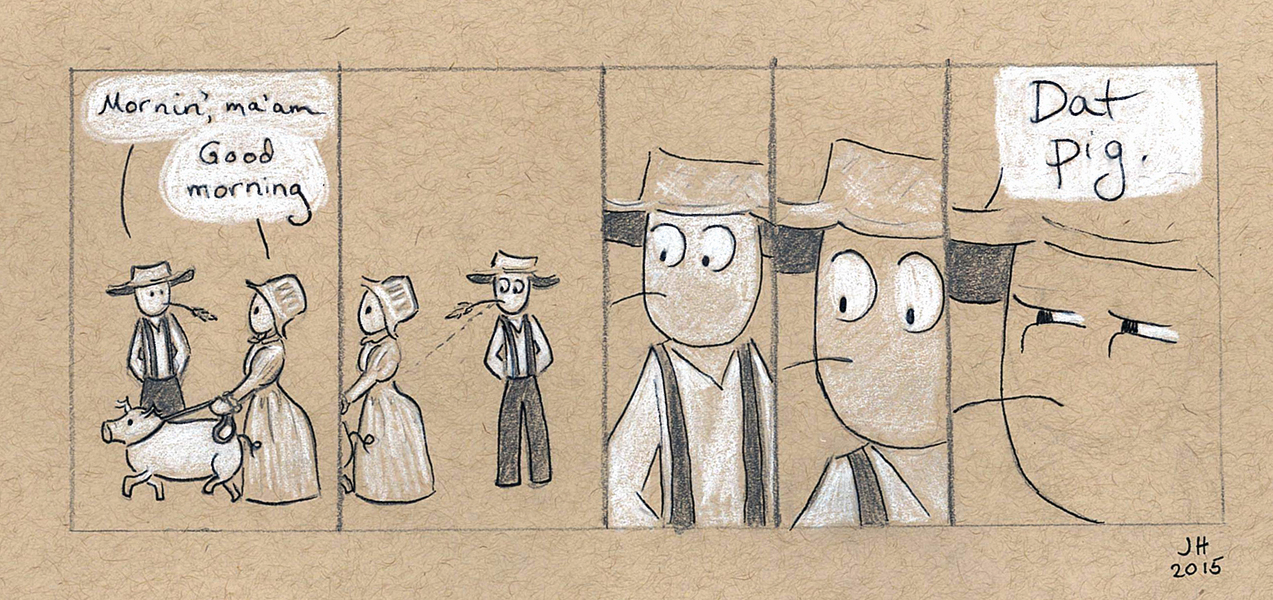
Pig theft, more than any other crime, defined frontier life in the Tennessee Valley. Although more cases dealt directly with retailing illegal whiskey without a license or brutal gang assaults, most cases did not specify the exact dollar amount of each bottle nor did the victims of violence always take vengeance upon their attackers. In fact, moonshining remained so prevalent that men accused of distributing alcohol without a license often served as jurors because they were recognized as “good and lawful men of the county,” like Littleberry Adams.* Yet pig theft remained a relatively static crime – someone swindled swine all the time – and it exhibited symbolic elements of the Anglo-American migration onto the cotton frontier.
Ambrose Foster and Thomas Moore received the first indictments for pig theft in Madison county history. Theirs is an interesting tale. Neither appeared in the 1809 census; so it’s likely that they arrived from Tennessee, Virginia, or North Carolina** and both are listed as laborers. The men took turns at porcine plunder. Early in the morning on the first day of 1810, Thomas Moore roused his brother Nathaniel and readied himself for the day. For you see, Thomas had a plan. Together the Moores came to the small homestead of Ambrose Foster and, with pistols drawn, raided him for pigs. They came away with “one sandy colored hog, with a crop and under bit in the right ear and an under bit in the left ear,” that Foster estimated to be worth twelve pence. The Sheriff lodged his complaint and explained that the Moore boys would appear before Obadiah Jones at the April 1811 session of the Superior Court.
Ambrose Foster didn’t play that.
He knew they’d have eaten his hog by then, so he set out to avenge his depleted stocks of walking pork chops. On January 30, 1810, Foster came onto their farm and “did take and carry away, one black and white hog with a swallow fork in the right ear and an under bit in the left ear.” I imagine Foster saw the under bit in the left ear and felt a great contentment. He may have reasoned with himself that the Moores simply painted his pig to better hide their audacious theft. ‘Besides,’ his internal monologue probably ran, ‘it’s not hard to make a swallow fork – all you need is a knife and a pig’s ear. Those idiots got both.’ When Thomas Moore lodged the suit against Ambrose Foster, he made sure to value the pig at only six pence.
Although the jury dismissed both suits the struggle between Ambrose Foster and Thomas Moore remained emblematic of the tit-for-tat repercussions that came with hog theft.
Cooperation between multiple criminals remained one of the most surprising aspects of hog theft. Although the solitary Ambrose Foster managed to avenge himself against the Moore brothers; it often took several men to steal some swine. In January 1812, it took both John McMahon and John Miller to steal “a certain spotted sow” from William Thompson.***
Of course, it’s worth noting that the hog hustle most often occurred during the depths of winter, when wage labor is least requested and stocks ran low. Hunger, occasionally tinged with vengeance, motivated these thefts. As more immigrants moved into Madison county, the frequency of hog thefts diminished. Although people still stole pigs, its role as a necessary function of survival decreased as the Tennessee Valley became more materially advanced. Instead of solely appropriating hogs; people now stole horses, bee hives, and cattle. Livestock theft reflected the overall wealth of the settlers.
So much so that it took a solid two years before another harsh winter inspired a renewed interest in old traditions. December 20, 1814, saw John Lively steal a six dollar sow from Barnett Tatum. The pattern emerged yet again during January 1816, when it took four men to steal a single hog from John Craig.
Just as the propensity for Anglos to steal hogs from each other depended upon economic conditions, so too did the willingness of whites to rob their indigenous neighbors depend upon the relations between the Mississippi Territory and the respective First Nations. It should surprise no one to learn that the greatest hog theft occurred when a band of white settlers raided “John Brown, Junior, a friendly Indian of said Cherokee Nation or Tribe,” in December 1817. Thomas Billingsly, Jesse Reynolds, George Hale, and Alexander Williams entered the borders of the Cherokee Nation in “Blunt County,” without their required passports, and stole thirty-two hogs valued at $88.20.
After stealing what amounted to a small walking fortune, the men turned their attention to John Brown and “with guns, clubs and fists did assault and menace him.” Their raid on John Brown featured not only the greatest amount of hogs stolen, but also included the only recorded assault on a person during a hog theft. They stole his hogs not to simply divide one among themselves to make it through the winter but did so to categorically deny an indigenous person access to wealth. Not content to deprive the man of his hogs, they then physically and mentally humiliated him. The jury acquitted them on all charges.
A study of hog theft might seem like a small thing, but it illuminates much about Madison county during the territorial period. We’ve seen the economic necessity of occasionally raiding one’s neighbors, the decrease in theft as related to material wealth, a dramatic hog based feud between two families, and ultimately the use of formerly frowned upon frontier practices to assist in the forced removal of indigenous Alabamians from their livelihoods and land.
All for the love of hogs.
*who served as a juror for the Foster/Moore pig controversy
**the three states with the highest amount of Anglo immigration into Madison county during the territorial period, in that order.
***apparently neither man could stay out of court, a later proclamation by Obadiah Jones commanded the Sheriff to find both men so that they might be prosecuted and to take an estimated five hundred dollars worth of their personal property to cover court costs, John McMahan briefly emerges again in 1816, during a feud with a man named William Gibson that resulted in the death of his brother William McMahan.
The Territory v. Ambrose Foster, Minute Book of Madison County Mississippi Territory of the Superior Court in Law and Equity, 1811-1819. p. 6/5-7/5 (1810).
The Territory v. Thomas Moore, Minute Book of Madison County Mississippi Territory of the Superior Court in Law and Equity, 1811-1819. p. 8/7-10/8 (1810).
The Territory v. John McMahon & John Miller, Minute Book of Madison County Mississippi Territory of the Superior Court in Law and Equity, 1811-1819. p. 33/31 (1812).
The Territory v. John Lively, Minute Book of Madison County Mississippi Territory of the Superior Court in Law and Equity, 1811-1819. p. 148/118-150/119 (1815).
The Territory v. Ringo et al, Minute Book of Madison County Mississippi Territory of the Superior Court in Law and Equity, 1811-1819. p. 194/155 (1816).
The Territory v. Thomas Billingsly, Minute Book of Madison County Mississippi Territory of the Superior Court in Law and Equity, 1811-1819. p. 275/225-277/227 (1818).
Elizabeth Minor spent nine years refusing to do housework or tending to “any of those domestic duties which a wife ought to perform.” Originally married in Lunenburg county, Virginia, sometime during the year 1824; her husband soon moved their fledgling family to Morgan county, Alabama in the hope of furthering his wealth. He made sure to emphasize his position as “extremely poor… and in reduced circumstances,” and blamed her refusal to take part in the domestic economy for the continuation of his ill fortunes.
It may be worth noting that ‘domestic duties which a wife ought to perform’ in nineteenth century Alabama encompassed everything from mundanities like sewing, gardening, and churning butter – to the gory tasks of hog slaughter or child birth. Taken all together, her husband probably expected Elizabeth Minor to be equal parts sweat shop, botanist, chemist, and butcher. Which is a terrifying and post-apocalyptic skill set for any one human to possess, much less an entire gender.
Lankton Minor convinced himself that his wife simply entered an unexpected stubborn phase. He soon discerned that the only way to convince her to stop doing whatever the hell she wanted was to simply flatter her into submissiveness. So he tested his theory that “by the most affectionate & kind treatment as a husband on his part he might ultimately restore her to her understanding.”
Yet still she refused.
Obviously Lankton Minor survived long enough to try and divorce her. Elizabeth Minor probably contributed in some way to the household, because although her husband alleged that “[h]er management of the house was so wretched that a relation of it would shock every feeling of humanity,” he stuck around long enough for her to abandon him.
Although he described how her “want of cleanliness and anything like modesty* rendered the house of your petitioner… almost intolerable,” there is no mention of her committing any acts of adultery nor stealing anything from him. Husbands of the time made sure to mention non-sanctioned coitus first and foremost in their testimonies against their wives, so we can assume that she did not get intimate with an immigrant. They also highlighted any financial indiscretions on the part of their wives so as to hopefully avoid alimony.
Instead, it appears that she simply tired of him. Lankton Minor used a lot of creative language in describing Elizabeth Minor as unfit for social enjoyment, mentally deranged, possessing a defective imagination, and full of “thoughtless expression.” So he may have just pissed her off. Indeed, she apparently warned him for several years that she planned to depart, but he brushed that off as the mindless chatter of his insane wife.
Until she left.
It may seem that I’m being needlessly harsh with Lankton Minor’s accusation, but allow me to explain. Although we’re supposed to believe that Elizabeth Minor possessed less than reasonable mental faculties, she successfully navigated back to her father’s home in Prince Edward county, Virginia, on foot. Other divorce cases of the time make specific mention of rich to middling income women hiring scouts to lead them along a trail to unite with a lover only two counties over, yet somehow a supposed invalid walked about six hundred miles without incident in 1833.
Elizabeth Minor just hated doing housework. It should please most to hear that Lankton Minor’s appeal was dismissed and he lived the rest of his life unable to remarry.
*one can only assume that she walked around naked a lot
citation:
Lankton PB Minor v. Elizabeth Minor, Book K, 387-389 (1834).
John Roller did nothing extraordinary, but he happened to be nearby when mildly interesting things happened. His status as a white male head of household meant that he often represented several people at once, as such, the brief descriptions we have of his life emerge not from his own tribulations but from the actions of his family, friends, and enemies.
Roller migrated to Madison county sometime prior to 1809. The same year that the county conducted a rather informal census. It tells us that he brought five other family members with him; two men over the age of 21, one under, and a young woman below the legal age of majority. An 1811 court case listed his occupation as laborer and the 1809 census tells us he owned no slaves. John Roller performed odd jobs to survive and presumably support his younger relatives.
We do know that he befriended, or worked for, a man named Dillon Blevins. Blevins proved to be a man of some means, the 1809 census indicates that he owned at least ten slaves, so it’s entirely a toss up as to whether Roller’s criminal relationship with Blevins emerged from fraternal love or economic necessity. We do know that John Roller participated, along with his relative Jacob Roller, in an 1811 assault that Dillon Blevins launched against a man named Stephen Smith.
Blevins, the Rollers, and recent immigrants William Dorton and James Moore crept onto Smith’s property and found several hewed trees. Smith intended to build a cabin upon his newly purchased land, but the posse had other ideas. They talked it over for a moment and then “did move forward and burn the logs of said Stephen Smith, intended for a house.” Smith remembered their faces and later lodged a complaint with the Sheriff, who only managed to arrest Dillon Blevins and John Roller.
We know Blevins to be the primary instigator due to further indictments against him. Although the original document that accused John Roller fails to mention the date; two later court cases prosecuted entirely against Blevins claimed that on January 21, 1811, he threatened Smith “by pointing and cocking his gun… in an angry manner”* and apparently on February, 24, 1811, Blevins burned down “a number of logs hewed and intended to be made into a house, by said Smith.” There’s no evidence to indicate whether Smith decided to sue Blevins twice for the same assault or if Blevins just periodically burned down all his shit. So I’m choosing to believe the latter.
Obadiah Jones eventually vindicated John Roller and freed him from the county jail in October 1811. Roller returned to the daily grind of laboring all over Madison county and generally being inoffensive. Eventually he met a woman named Nancy Bealor and the two married in the early April of 1812. It looked to be a good year.
He filed for divorce in November of 1812. Nancy Roller left his home and disappeared to some unmentioned corner of America. Indeed, John Roller quickly faded from the public record after his divorce, so it only seems fitting to allow the man to briefly speak about his estranged wife, if only through his pleas to Obadiah Jones:
The object of your orator in marrying the said Nancy, was to live in the bonds of connubial enjoyment, with a partner who would be kind and tender in the hour of afflictions and difficulties, and chast and virtuous in her demeanour as a wife… But to the disappointment and mortification of your orator, but a short time had elapsed before she committed innumerous breaches of that contract… his said wife Nancy has committed many acts of adultery and incontinency with different individuals, for such has been her unchaste and vicious disposition and habits, that she has not confined her acts of illicit intercourse to any one individual alone, but she has indulged with, and been common to, all who thought proper to solicit.
John Roller officially divorced Nancy Roller on May 12, 1813. We’ve heard very little from him since.
*although I’ve never experienced someone pointing their gun at me in a friendly manner
citation:
“1809 Census of Madison County” Valley Leaves 1 (1966): 44.**
The Territory v. Dillon Blevins, William Dorton, John Roller, and Jacob Roller, Minute Book of Madison County Mississippi Territory of the Superior Court in Law and Equity, 1811-1819. p. 10/9-10/10 (1811).
The Territory v. Dillon Blevins, Minute Book of Madison County Mississippi Territory of the Superior Court in Law and Equity, 1811-1819. p. 24/22 (1811).
The Territory v. Dillon Blevins, Minute Book of Madison County Mississippi Territory of the Superior Court in Law and Equity, 1811-1819. p. 24/23-25/23 (1811).
John Roller v. Nancy Roller, Book A, 8-10, (1812).
** Valley Leaves is a publication of the Tennessee Valley Genealogical Society.
Eli Newman waited for most of November fifth. He began that Saturday in jail and ended it in dirt. He probably stared at the gallows that awaited him and silently cursed the fact that he’d never see 1813, or Sunday, or one in the afternoon. Though he certainly saw nine o’clock. One can only wonder if his last definite hour of life moved like a slug or a hummingbird. The previous Monday Judge Obadiah Jones left him a broad window of execution, but sometime between “ten in the forenoon and two in the afternoon,” he hanged.
152 days earlier Eli Newman killed Joseph Tetrick. He never denied his crime, only the ability of Madison county to prosecute it. For Eli Newman assaulted the man on the eastern lands of the Chickasaw Nation, a place that someday became Lawrence County. He sliced a two-inch ditch in Tetrick’s neck for an unstated reason, but did so with “a certain instrument called a razor, of the value of one dollar.” He referred to himself in court documents as a “traverser,” indicating that he passed through the Chickasaw Nation, and indeed Alabama, on his way to somewhere else. Documents are unclear on whether or not the Sheriff recovered the certain instrument.
Lewis Edwards appeared in court the same day as Eli Newman. Edwards actually spoke to Obadiah Jones immediately prior to Newman receiving his death sentence. He stood accused, on that first Monday in November, of robbing Archilaus Craft barely a month earlier. On October first of 1812 he carried away “a certain spotted handle razor, of the value of one dollar,” from the home of Craft* and back into Madison county.
It was a razor kind of day.
*more research is required but a quick perusal of some genealogical sites indicate that an Archilaus Craft may have lived in or near the contemporary boundaries of the Chickasaw Nation. while I am not impugning upon the reputation of Archilaus Craft by suggesting that he murdered Tetrick, I do think it’d be cool if it was the same razor and he found it in the woods after Newman tossed it aside. Eli Newman was an outsider and his plea makes quite clear that Madison county already tried him for this crime two previous times – it seems that the Sheriff finally stacked a jury that would deliver a death sentence.
citation:
The Territory vs. Lewis Edwards, Minute Book of Madison County Mississippi Territory of the Superior Court in Law and Equity, 1811-1819. p. 51/45-52/45 (1812).
The Territory vs. Eli Newman, Minute Book of Madison County Mississippi Territory of the Superior Court in Law and Equity, 1811-1819. p. 53/46-58/49 (1812).
We will never know why John B. Haynes hated houses. From his brief description as a “yeoman” in various court documents it appears that he owned one. Nor will we ever know what Cary Bibb did to anger him, like William Badger, it appears that she* and her property simply existed at a point in time when John B. Haynes wished for its discontinuation. What we do know is this:
Sometime during the day of January 10, 1814, John B. Haynes “did riotously and unlawfully assemble at the dwelling house of Cary Bibb.” At this point in the narration I feel it necessary to highlight that someone underlined riotously. Haynes forced his way inside her home and brought his friend, George Hays, with him. Cary Bibb testified that eight men in total entered her home, though she only recognized Haynes and Hays. They brought guns to emphasize their point. Once the men finished assembling all hell broke loose.
John B. Haynes looked around the house of a probable widow, “and did then and there destroy and injure the household furniture of the said Bibb…to the great terror of all other good citizens and against the peace and dignity of the Mississippi Territory,”
This man hated furniture more than you will ever hate anything else in your life.
*after the case was dismissed in favor of John B. Haynes (I have a feeling that the Grand Jury simply feared him visiting their homes), judge Obadiah Jones ordered a certain Samuel Donahoo to pay the court costs. Although Cary is a unisex name the presence of Samuel Donahoo indicates that he was ‘her next friend’ – an old legal term to describe the male representing a grown-ass woman in a court case. Although solicitors/lawyers often served as next friends, the lack of his mention prior to discussing court costs leaves me to believe that Samuel Donahoo is a male relative and that Cary Bibb might be a widow. Although this is a very tenuous line of reasoning.
citation:
The Territory v. John B. Haynes, Minute Book of Madison County Mississippi Territory of the Superior Court in Law and Equity, 1811-1819. p. 184/148-185/149 (1814).
On September 24, 1811, William Winston and Solomon Malone got into an argument. Extant records list both men as labourers. In short, they cut logs and hauled rocks for a living. One can only assume that it was an argument about rocks, possibly logs.
It escalated.
It escalated to the point that William Winston punched the poor Solomon Malone and pulled out a weapon. They tangled for a moment and then William turned quickly and “did then and there did stab him, the said Solomon, with a large knife of the value of two shillings in the arm just below the elbow with intent to kill him.”
We learned a lot about Solomon Malone with this sentence. He was the kind of man to be nearly stabbed in the ribs, to be almost murdered, and to pause to say to himself “that is a knife of median value. I should note this for later.”
Solomon Malone had strange priorities.
citation:
The Territory v. William Winston, Minute Book of Madison County Mississippi Territory of the Superior Court in Law and Equity, 1811-1819. p. 34/36-37 (1811).
March, 1837, saw a simple wedding in Jackson County, Alabama. Although the details are sparse we can make a few assumptions:
It certainly happened in a church.
They probably wedded in the same place they registered their marriage, the town of Bellefonte, a previous county seat and current uninhabited waste.
The groom had other plans.
On the morning of April 20, 1837, James Monroe Elliott left Alabama for Arkansas. The previous years saw punishing winters and slow springs. Tree sap hardened and bent the bark until it exploded. Amber colored ice snapped outwards and people across north Alabama reported the sounds of pistol fire all through the night. Pack horses trotted over frozen creeks. Things didn’t warm up until a drought in 1840.
James Elliott faced a difficult journey. When he left, it was not to find mules and bring them back to the frontier by force of his own stubbornness. He did not leave to purchase seed nor cattle nor medicine. He just left.
Elizabeth Elliott stood in the Madison county courthouse on February 17, 1840. She held a son born on the last day of 1837. She named him James. He never met his father. Her solicitor, Jonathan Thompson, explained her situation to the chancery judge.
Elizabeth wrote letters to her husband’s family inquiring about his whereabouts. The replies revealed the life of a restless man. His father said James wrote him from his new home. He’d made it to Arkansas and saw fit to take another wife. By 1839, James Monroe Elliott grew tired of rice fields and razorback hogs and emigrated to the newly formed Coffee county, Tennessee. Far enough to avoid the Arkansas wife but too close to keep his mind off Elizabeth. He wrote her a letter and stated simply that he’d met and married a third woman.
Coffee county did not suit the man. He soon left his third wife, and only history knows how many children, and traveled to western Tennessee. From the banks of the Mississippi he looked out and saw a new republic carved from the Mexican hinterland. Like so many Anglo men before him, James Monroe Elliott went to Texas.
Of course, he did not go alone. Elizabeth Elliott sums up the last known destination of her husband, “he has abandoned his third wife, and after inveigling the affection of a female relative of his in the western part of Tennessee, he finally persuaded her to leave her home, and go with him to the Republic of Texas, in the capacity of wife or concubine.”
Elizabeth Elliott struggled on to raise a son in Madison county. She earned the money to pursue her divorce by doing odd jobs and through force of will, but ultimately found little satisfaction with the courts. Without a response from James Elliott or some other witnesses the chancery court couldn’t fully prosecute. She dropped her suit against James on May 29, 1843. She’d been married for six years.
citation:
Elizabeth Elliot v. James Monroe Elliot, Book M, 304-306 (1840)
Information about 19th century weather conditions available from
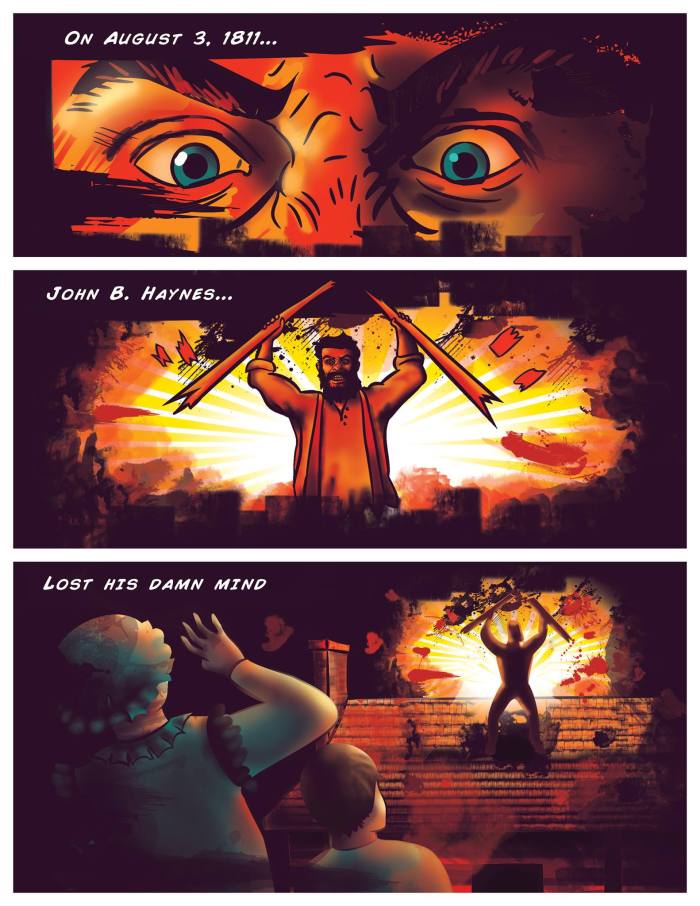
Sometime in the middle of the night he trespassed upon the property of William Badger – a local silversmith, and proceeded to utterly wreck his shit. The short court document tells us that John B. Haynes smashed windows, tore up stones and threw them at Badger’s cabin, and uprooted fence posts – if for no other reason then they happened to be nearby.
via Erica Lane
However, this was not the totality of his white-hot cabin-hating fury. For although a badly beaten William Badger lay nearby, his wife and children huddled in prayer, as the madman known only to the world as John B. Haynes tore apart their home and property; it occurred to Haynes that he had not sufficiently destroyed the cabin of Twickenham’s only silver smith. So with the hulk-like strength so often found among colonial settlers of the southeast, John B. Haynes “did violently and maliciously… tear off the roof”
How angry do you have to be at someone to tear apart the roof of their cabin, log by log, in the middle of the night?
John B. Haynes angry. That’s what.
ADDENDUM: Apparently Haynes came back a week later to “then and there beat, wound, and illtreat to the great damage of the said Badger, and against the peace and dignity of the Mississippi Territory.”
John B. Haynes angry.
citation:
The Territory v. John B. Haynes, Minute Book of Madison County Mississippi Territory of the Superior Court in Law and Equity, 1811-1819. p. 20-18 (1811).

 huntsvillain